

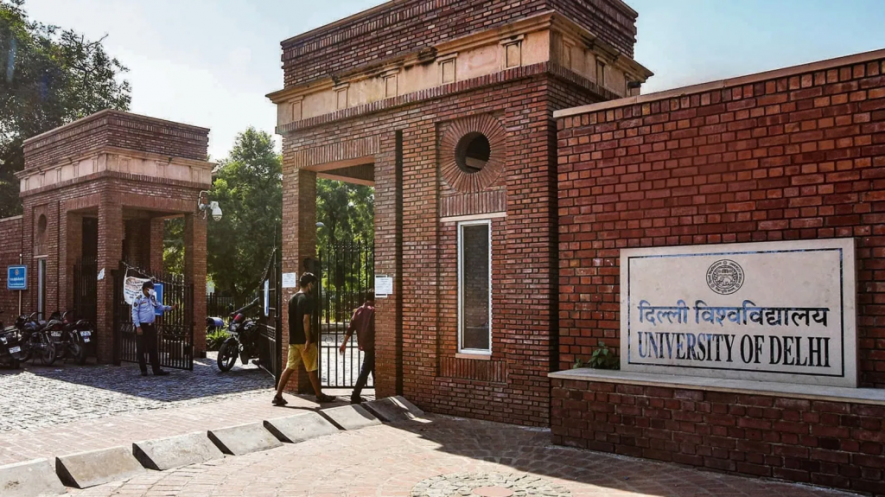
Students pursuing the four-year undergraduate programme (FYUP) face important choices both at the end of the third year and on completing the fourth year. Should they leave after three years with a recognised degree or continue into the fourth year? After completing four years, should they pursue a one-year master's degree, seek employment or apply for a PhD? The central question, therefore, is how these pathways can be made meaningful and beneficial to students.
Two views in the Dis/Agree column:
Mamidala Jagadesh Kumar, former UGC chairman, argues FYUP has built-in flexibility. A student can exit after earning a minimum of 120 credits and receive a three-year degree. In addition, institutions can offer either an Accelerated Degree Programme (ADP) or an Extended Degree Programme (EDP). In ADP, an eligible student can complete the FYUP in six or seven semesters. It provides routes to Honours and Honours with Research. The UGC's 2025 Apprenticeship Embedded Degree Programme guidelines permit up to four semesters of apprenticeship in eligible establishments, including industries, MSMEs and start-ups.
Read more - Rewa N-Power Push Hits PESA Wall
The success of FYUP should not be judged solely by number of students who continue into fourth year. IISc introduced its four-year BS (Research) degree in 2011. Over past 15 years, it has grown into an interdisciplinary and research-intensive undergraduate programme. Another example is IIT Madras's four-year BS degree in Data Science. Launched in 2022, it has gained substantial popularity.
Debraj Mookerjee counters: The FYUP bears twin burden of ambition and ideology. On one hand, it is tight-jacketed by a narrow and deterministic set of principles on how higher education should be guarded. On the other, it is imagined as a stage where a decolonised knowledge system can be performatively enacted to reorient future generations into a certain version of Bharatiyaness. The former encodes compliance; the latter seeks alignment.
Higher education is most productive when it is untethered. Knowledge forms where there is freedom. On a ship you need strict systems and protocols inside the engine room. Processes are important and necessary in certain types of functions, and even in education: standardisation in grading, well thought-out syllabi. However, if you over-schematise education itself, you make it lose its core purpose - to foster a love for knowledge, and provide environment for formation of new knowledge.
Read more - The Serious Stagnation
Regardless of whether NEP has merit or otherwise, its implementation across India's universities has experienced roadblocks. Guidelines and rules are often formulated after programmes are started, unclear rules of engagement leave teachers and students clueless about requirements and entitlements, frequent changes and exacting requirements in face of weak infrastructure result in cutting corners to meet timelines, and most disturbingly, students are insecure in the absence of clarity.
For India, the lesson: flexibility without faculty and infrastructure is just confusion.
Tags: #FYUP #DelhiUniversity #NEP2020 #UGC #FourYearDegree #HigherEducation #ADP #Research #Bharatiyata