

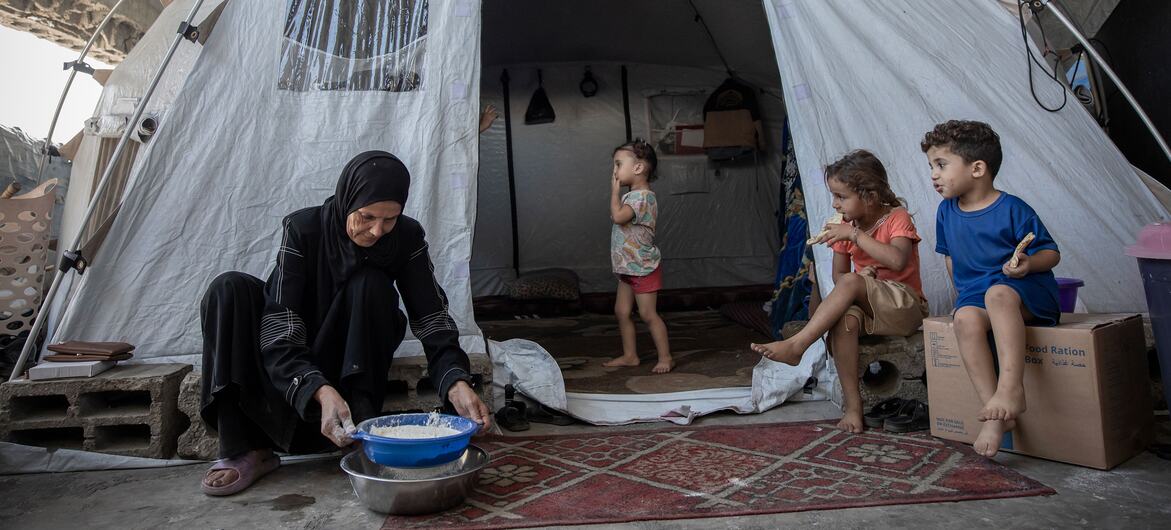
Families in Gaza are bracing for a fourth winter in tents that cannot withstand rain, wind or flood — while still under bombardment.
The UN Human Rights Office (OHCHR) warned Nov 1 that displacement in Gaza has become an "acute and chronic nightmare". Most Palestinians are entering their fourth year of displacement and fourth winter "inside frail tents that cannot withstand rain, while they remain vulnerable to bombardment".
Over the past two weeks, Israeli forces expanded westward in Al Shujaiyeh, Gaza City, and in three locations in Middle Gaza — eastern Al Bureij, eastern Deir Al-Balah and eastern Al Maghazi.
In that expansion, OHCHR documented "at least two Israeli attacks were reported on displacement camps" in Al Shujaiyeh, with forces using explosive robots to detonate the few buildings left. On Oct 25, a drone dropped munitions on tents at Al Shujaiyeh junction near the yellow line, fire burned for five hours and displaced 200 families comprising 800 people — mostly women, children and older persons.
Gaza's winter emergency committee says 7,800 tents sit in flood-prone low-lying areas and need urgent relocation, while roughly 200,000 dilapidated tents shelter hundreds of thousands. Another 2,000 structurally damaged buildings could collapse in storms, with families still sheltering inside destroyed structures.
Read more - The Ceasefire That Kills: Gaza's Fake Peace
The majority of Gazans continue to live in tents, 90% of power generation destroyed per World Bank, a single solar panel now 15,000 shekels ($5,000). In Khan Younis, former engineering student Kamal Al-Dabary builds wind turbines from scooter motors and water tanks to charge phones and lights — "every watt counts."
UN aid: Gaza's media office said only 3,777 aid trucks entered in October — 20.3% of the 18,600 stipulated under ceasefire. WFP cut food aid from 1.6M to 1.1M people. Parents skip meals. Infants died of hypothermia last winter — 11 children.
Israel says it aims to increase military deployment to 70% of Gaza's territory, up from about 53% under ceasefire arrangements to nearly 63% now.
West Bank — In parallel, at least 45 Palestinians were arrested across the occupied West Bank since Tuesday evening.
Al Jazeera reported Wednesday that Israeli forces detained at least 45 people since Tuesday, a minimum figure. Palestinian Prisoners Society says arrests include five women and two journalists — journalist Hazem Nasser rearrested two weeks after release, and Al Jazeera journalist Montaser Nassar detained near Hebron.
Read more - The Ceuta Lie Machine
Raids concentrated in Nablus and Hebron, with additional detentions in Qalqilya, Tulkarm, Bethlehem, Jenin, Qabatiya/Jenin, Deir al-Hatab/Nablus, Shuafat refugee camp/Jerusalem. Troops searched homes, blew up house of prisoner Ahmed Abu Rubb in Qabatiya, demolished house in Tuqu' south of Bethlehem, and caused gas inhalation among students in Al-Mughayyir north of Ramallah.
Israeli authorities also designated 2,536 dunams as "state property" across Beitillu, Al-Mazra'a al-Qibliya and Deir 'Ammar northwest of Ramallah.
Since Oct 2023, arrests in West Bank have reached approximately 21,000 cases, per Prisoners Club.
Hamas condemned the campaign as "part of a policy aimed at suppressing Palestinians and forcibly displacing them".
The UN warns such forced transfer could constitute war crimes.
#Gaza #WinterCrisis #DisplacementCamps #WestBank #MassArrests #Palestine #OHCHR #AlShujaiyeh #JournalistsArrested #GazaUnderBombing