

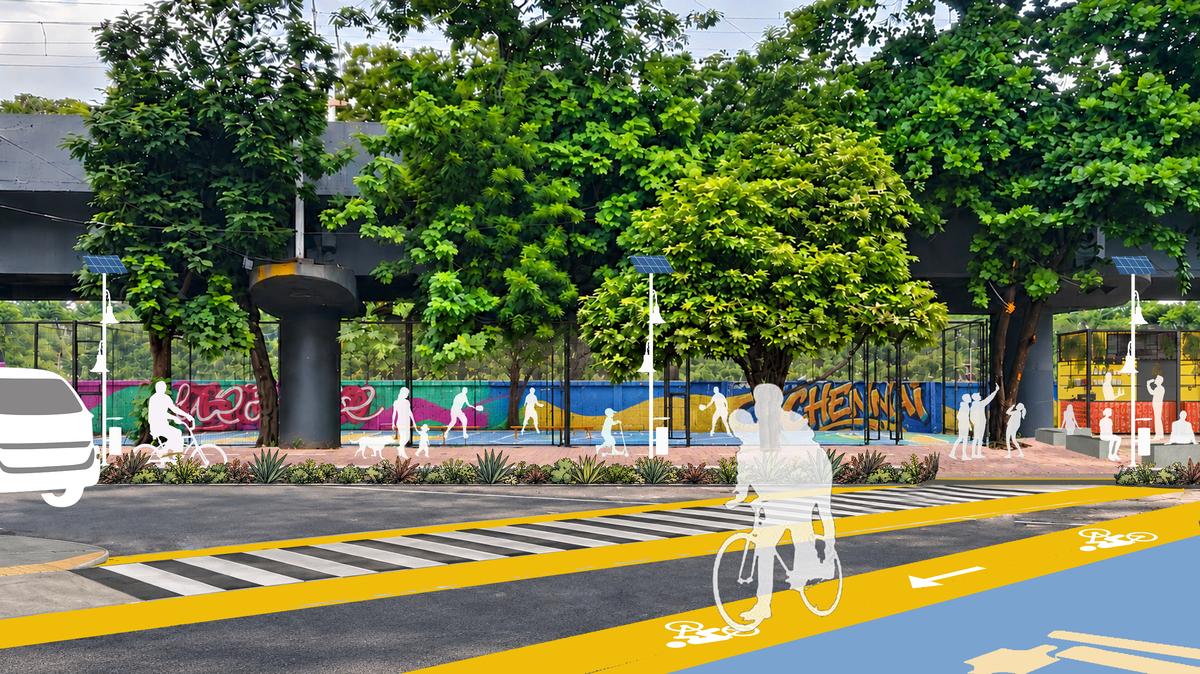
What if the dead space under the MRTS track near Wallajah Road became a pickleball court? What if a cricket stadium road was used even when there is no match?
Five architecture academicians from Chennai's MEASI Academy of Architecture sifted through these what-ifs and turned them into a national winning blueprint.
The team — Associate Professor Muzakkir G. M. Bijli, Silivinus Clisson Pragash, Anusree, Anjana Lakshmi and Sangamithra — won first prize and Rs 1 lakh cash at the national-level 'Indian Streets Reimagined Design' competition, held as part of the 18th GRIHA Summit 2026 at India Habitat Centre, New Delhi on Nov 3-4. The competition was conducted by GRIHA (Green Rating for Integrated Habitat Assessment) in association with Council of Architecture (CoA).
The brief was deceptively simple: pick an Indian street that offers clear opportunity to rethink how space is distributed among people, vehicles, commerce, landscape and public amenities while responding to local climate, urban context, cultural identity and character.
The team picked Wallajah Road — 2.5 km stretch from Triplicane to Chepauk, home to MA Chidambaram Stadium, University of Madras, and Triplicane Big Mosque. Despite being wide, the road remains largely underutilized outside IPL matches and major events, with poor footpaths, encroached vendors, and no shade.
Read more - City On The Clock
Their proposal centered on three moves:
1. Pedestrian first — continuous shaded footpaths with permeable pavers, universal accessibility ramps, cycle tracks segregated by bioswales.
2. Climate response — native trees like neem and pungam for Chennai heat, rain gardens to handle monsoon flooding, reflective cool pavements to cut heat island.
3. Productive underuse — revamping underutilized spaces below MRTS line for community uses — pickleball court, vendor zones, art kiosks — linking commerce to commute.
Judges noted that unlike generic beautification, the plan retained Wallajah's layered identity — cricket, colonial campus, Islamic precinct — while reclaiming 40% road space for people.
Read more - Slice House: The 4-Foot Homes You Can Unbuild
For GRIHA, India's own green rating system by TERI and MNRE, the competition signals shift from green buildings to green streets. For Chennai, where 60% trips are walking and public transport, Wallajah blueprint could be pilot for 20 other arterial roads.
Prize distribution was held at GRIHA Summit, India's largest conclave on sustainable habitats.
#GRIHA #MEASI #Chennai #WallajahRoad #SustainableDesign #IndianStreets #Architecture #GRIHASummit2026 #GreenBuilding #UrbanDesign