

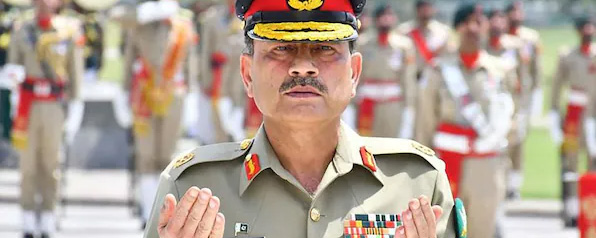
The formal invitation extended to Pakistan’s Chief of Army Staff, General Asim Munir, to attend the 250th US Army Day on June 14, 2025, is far more than a ceremonial gesture. On the intricate chessboard of South Asian geopolitics, this move is being interpreted as a calculated strategic maneuver—one layered with signals, implications, and deeper intent. For India, China, and Pakistan alike, it signifies a shift in how the United States is willing to reshape its diplomatic tools to safeguard its interests in the region.
The dominant role of Pakistan’s military in its domestic politics is no secret. In this context, Washington’s decision to directly engage with General Munir—not the civilian leadership in Islamabad—indicates a deliberate pivot towards Rawalpindi’s power center. It underlines the US’s pragmatic approach: choosing effective interlocutors over elected ones, especially when it seeks to balance China’s growing influence in South Asia by reviving dormant military ties.
This visit seems to be part of a broader, interest-driven US foreign policy strategy—one where democratic ideals often take a backseat to strategic imperatives. For Washington, the visit offers a direct line into Pakistan’s security apparatus, while sending a strong signal to Beijing that Islamabad may no longer be tethered exclusively to its orbit.
China, long regarded as Pakistan’s strategic guardian and the chief investor in the multi-billion-dollar China-Pakistan Economic Corridor (CPEC), is notably silent. That silence speaks volumes. It reflects Beijing’s discomfort with Pakistan’s apparent lean toward a multipolar foreign policy. If Pakistan indeed leans back toward American influence, it could introduce instability and uncertainty into projects like CPEC, potentially undermining years of Chinese investment and strategic planning.
China’s unease is not just economic—it is also deeply strategic. A reinvigorated US military presence in South Asia would directly challenge Beijing’s ambitions in the broader Indo-Pacific region. The implications extend well beyond Islamabad.
Domestically, the visit has triggered questions about Pakistan’s democratic integrity. Was General Munir’s visit authorized by the civilian government? Opposition parties in Pakistan argue that the elected government’s role in foreign affairs is steadily diminishing. If such high-level military diplomacy is conducted without transparency or civilian oversight, it only reinforces the perception that the country’s democratic institutions are hollowed out.
For India, the development cannot be ignored. Indo-US ties have reached unprecedented heights in recent years—evidenced by collaboration through QUAD, iCET, defense trade, and strategic dialogues. Yet, Washington’s direct military outreach to Pakistan, particularly its army, comes as a diplomatic jolt—especially at a time when militancy is resurging in Kashmir and Pakistan’s role in such unrest remains questionable.
India’s opposition, particularly the Congress party, has responded sharply. Jairam Ramesh called it a "diplomatic failure" and demanded a special session of Parliament to discuss the future of India-US strategic relations. This highlights how the episode has transcended international diplomacy to become a point of internal political contention in India.
To regard General Munir’s US visit as a mere military courtesy would be to miss the forest for the trees. It is a clear signal from Washington that a new power calculus is taking shape in South Asia—one in which practicality trumps principle. The active involvement of Pakistan’s military only underlines the fragility of its democratic framework. For China, it is a strategic setback. For India, it is a moment to recalibrate and remain vigilant.
Ultimately, this development underscores a truth of 21st-century diplomacy: enduring friendships are being replaced by flexible, interest-based alignments. In today’s global politics, trust is fleeting—balance, vigilance, and strategic clarity are the enduring pillars. The US’s move isn’t just a test for Pakistan—it’s also a measure of India’s strategic foresight.
Shreya Gupta is a trainee journalist at Cult Current. The views expressed in the article are her own
and do not necessarily reflect the official stance of Cult Current