

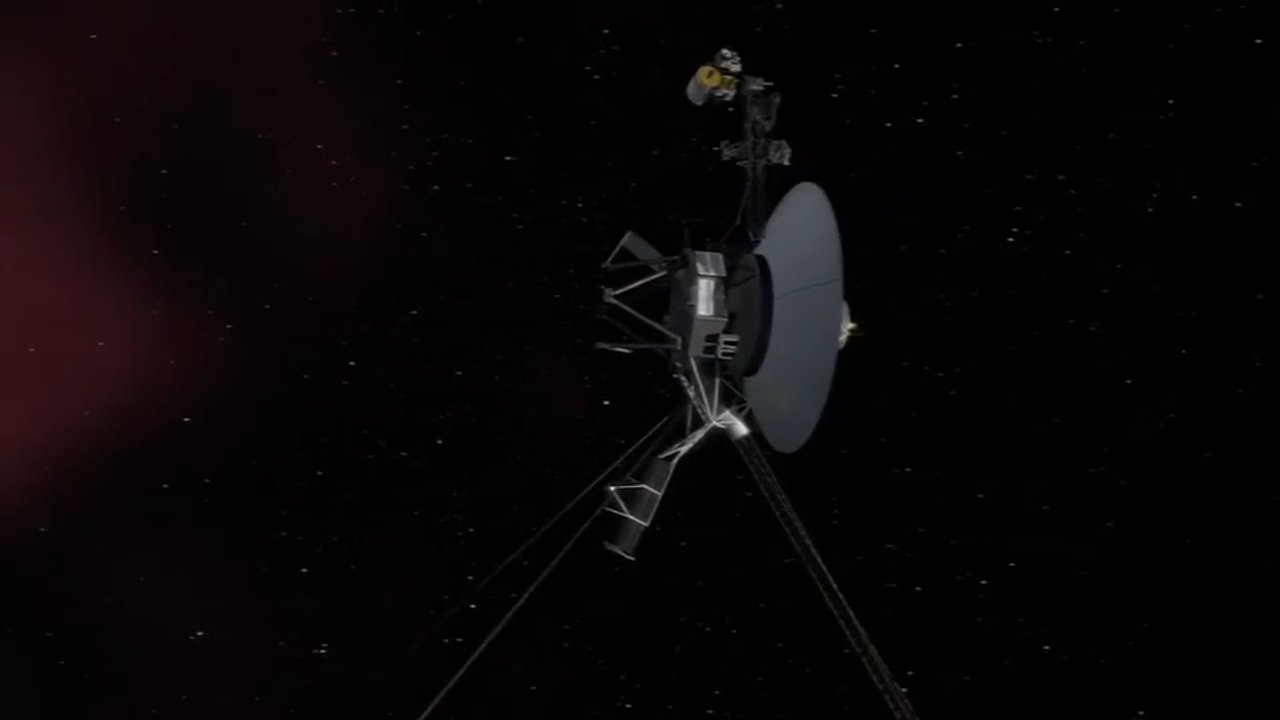
CAPE CANAVERAL: NASA's Voyager 1 phones home from awe-inspiring one light-day away. NASA's Voyager 1 phoned home one light-day away humanity's first emissary cross monumental threshold way out interstellar space.
Flight controllers received spacecraft's call Thu exactly 24 hours after sent. That's how long took radio signal traverse more 16 billion miles (26 billion km) speed light.
"Voyager 1 light-day distance confirmed ... After 16 billion miles exploration, Voyager 1 continues journey unknown," controller Nshan Kazaryan announced cheers applause.
NASA could not confirm newest distance record until signal reached control team California Jet Propulsion Laboratory via Deep Space Network antenna near Madrid Spain relayed mission team JPL.
"Traveling a light-day is singular feat spacecraft, but Voyager so much more distant traveler," NASA's Joe Westlake heliophysics division director said statement.
"Voyager 1 crossing light-day threshold yet another historic feat extraordinary voyage discovery," JPL director Dave Gallagher said statement.
*What is 1 light-day?*
Light travels 299,792 km/sec. In 24 hours: 25.9 billion km. That's 173 AU — 173 times Earth-Sun distance. Sunlight takes 8 min 20 sec reach Earth. Voyager's light takes 1 day.
Nearest star Proxima Centauri 4.24 light-YEARS away — 1,550 light-days. Voyager would need 40,000 years to reach Gliese 445, its target star 17.6 light-years away, travelling 38,000 mph (61,000 km/h).
It became most distant human-made object 1998 crossed heliosphere Sun's sphere influence enter interstellar space 2012.
Voyager 1 launched Sept 5 1977 — 49 years ago. Twin Voyager 2 launched Aug 20 1977 entered interstellar space 2018 won't reach one-light-day mark until Nov 2035 — because slower, different trajectory.
Voyager 1 now operates 2 scientific instruments while Voyager 2 has 3. Both continue transmit valuable information environment never previously explored human-made objects.
*But — silence:*
Over weekend Voyager 1 stream science engineering data came abrupt halt. No science engineering data received since Sat according NASA. However carrier signal normally conveys data kept coming strong along flight path calculations allowed team confirm light-day milestone.
Engineers suspect fault — maybe transmitter switched backup, computer glitch, power dip. Same happened Nov 2023: Voyager sent gibberish for 5 months, team fixed from 24 hrs away by patching code in 1970s assembly language. And Oct 2024: switched to backup transmitter S-band after X-band failed.
Now team sending commands — each command takes 24 hrs to arrive, reply 24 hrs back. 48-hr round trip. Diagnosis will take weeks.
Power: Plutonium RTG decays 4 watts/year. Now ∼60% original. NASA turning off heaters, instruments one by one to keep alive till ∼2030s. By 2030, may not have power to transmit.
*Golden Record — still out there:*
On board: 12-inch gold-plated copper record — greetings 55 languages, music Bach to Chuck Berry, whale sounds, brainwaves, images, "Hello from children of planet Earth." Plus 90-min music, sounds Earth.
If aliens find it in 40,000 years, they'll hear Hindi? Yes — Hindi greeting included.
*Why this matters:*
Voyager is only probe in interstellar space — measuring plasma density, cosmic rays, magnetic field _outside_ Sun's bubble. Data changed textbooks: heliosphere not comet-shaped, but croissant-shaped. Interstellar medium denser than thought.
No other mission will go that far for decades. Interstellar Probe proposed 2030s would take 50 years to 1,000 AU. Voyager is our only eyes there.
*Timeline:*
- 1977: Launch Titan IIIE-Centaur
- 1979: Jupiter — discovered volcanic Io
- 1980: Saturn — rings, Titan
- 1990: Pale Blue Dot photo — Earth 0.12 pixel from 6B km, Carl Sagan
- 1998: Farthest human object
- 2012: Interstellar space
- 2026: 1 light-day
Voyager 1 is 825 kg, size car, power 470 watts at launch — less than hair dryer. Computer 69 KB memory — less than car key fob. Yet still calling home.
It will outlive us all. In 40,000 years, it passes Gliese 445. In 300,000 years, it passes Sirius. Long after Sun dies, Voyager + Golden Record will still drift — a time capsule that says: we were here.
#Voyager1 #NASA #JPL #Interstellar #Space #LightDay #GoldenRecord #Voyager2 #Astronomy #DeepSpace