

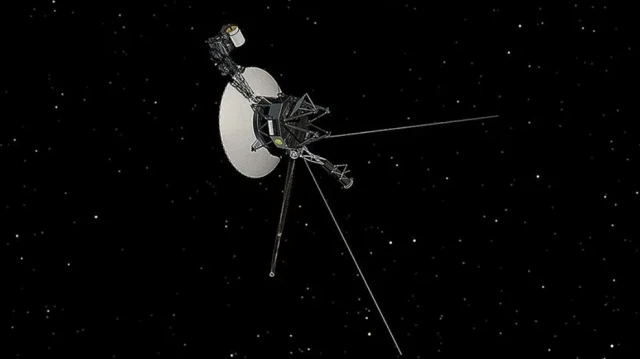
WASHINGTON: NASA Voyager 1 probe traveling through space nearly 50 years hit milestone distance one light-day away Earth Wednesday.
Already most distant man-made object universe spacecraft now about 26 bn km 16 bn miles away according US space agency. That distance particle light can travel 24 hours.
Reached milestone Nov 18, 5:16am EST 2:16am PST 3:46pm IST 16.094 bn miles 25.902 bn km Earth. Travelling around 38,000 mph 61,000 kmph Voyager 1 taken nearly five decades reach distance light covers just 24 hours.
A light-day measurement distance not time represents how far light travels 24 hours approx 186,000 miles 299,000 km second. At Voyager 1 distance radio signals carrying instructions Earth take about 24 hours arrive response spacecraft another 24 hours.
As Suzanne Dodd Voyager project manager NASA Jet Propulsion Laboratory explained Oct: “If you want to say 'hello' to Voyager, you send your message and then you go home and you wait two days before you finally get a response.”
Historic feat "best illustration just how vast space is," JPL exoplanetary scientist Tiffany Kataria said. “So much what we dream about traveling other stellar systems. And it took Voyager 1 nearly 50 years get just edge our own solar system, let alone only a light-day.”
NASA expects Voyager 1 take about 18,000 years travel full light-year.
1977 journey:
Voyager 1 launched Sept 5 1977 16 days after identical Voyager 2 Cape Canaveral Florida. Twin spacecraft launched tour giant planets Jupiter Saturn Uranus Neptune. Voyager 1 flew past Jupiter Saturn while Voyager 2 went Uranus Neptune still only spacecraft visit either one.
In 1998 surpassed Pioneer 10 become most distant human-made object Earth. In 2012 Voyager 1 first human-made object enter interstellar space region beyond Sun heliosphere protective bubble particles magnetic fields produced sun. Twin Voyager 2 entered interstellar space 2018.
Voyager 2 expected reach one light-day Nov 2035 nine years later.
In summer 2027 Voyager 1 Voyager 2 spacecraft each reach milestone time Sept 5 Aug 20 respectively each spent 50 years space.
Still alive 1970s tech:
Remarkable functioning relic 1970s technology survived well past expected lifespan. Originally 5-year mission.
Of course spacecraft no longer works well prime. Eight original 10 instruments not operating output plutonium-238 power source degrades little bit each year.
NASA engineers always found way use backup thrusters reroute data keep spacecraft operating long enough reach distance one light-day Earth. Power increasingly limited forcing mission engineers conserve energy shutting down nonessential systems. Still sends data Earth despite age dwindling power.
Instruments still operating: Plasma Wave System designed University Iowa, Magnetometer, Plasma Wave? Actually PWS, MAG, LECP, CRS — measuring interstellar plasma density magnetic fields cosmic rays.
Iowa-connected: William Kurth research scientist Iowa witnessed launch Sept 5 1977 Cape Canaveral involved mission ever since. Information sent Voyager including plasma wave instrument designed Iowa now takes full day traveling speed light reach Earth. Voyager 1 now 16 bn miles equivalent circling Earth 645,000 times.
Where going:
Voyager 1 headed toward Gliese 445 distant star more 17 light-years away Earth. Although speeding nearly 38,000 mph since 1977 still take about 40,000 years make closest approach within 1.7 light-years.
Carries Golden Record — gold-plated copper disc greetings 55 languages music images sounds Earth — message any civilisation finds it.
One-light-day milestone does not mark new physical boundary space cause any change aboard Voyager 1. Does not mean approaching end journey. Voyager 1 keep moving interstellar space long after instruments stop functioning contact Earth lost.
People shine lights during "Shine Bright for Voyager 1 Light-Day" celebration marking milestone California Institute Technology Pasadena Tuesday night. NASA asked public celebrate sending spacecraft signal evening Nov 17.
49 years to go one light-day. Nearest star 4.24 light-years — 70,000 years Voyager speed. Vastness humbling.
#Voyager1 #NASA #Space #Interstellar #JPL #GoldenRecord #LightDay #Astronomy #Voyager2 #Science