

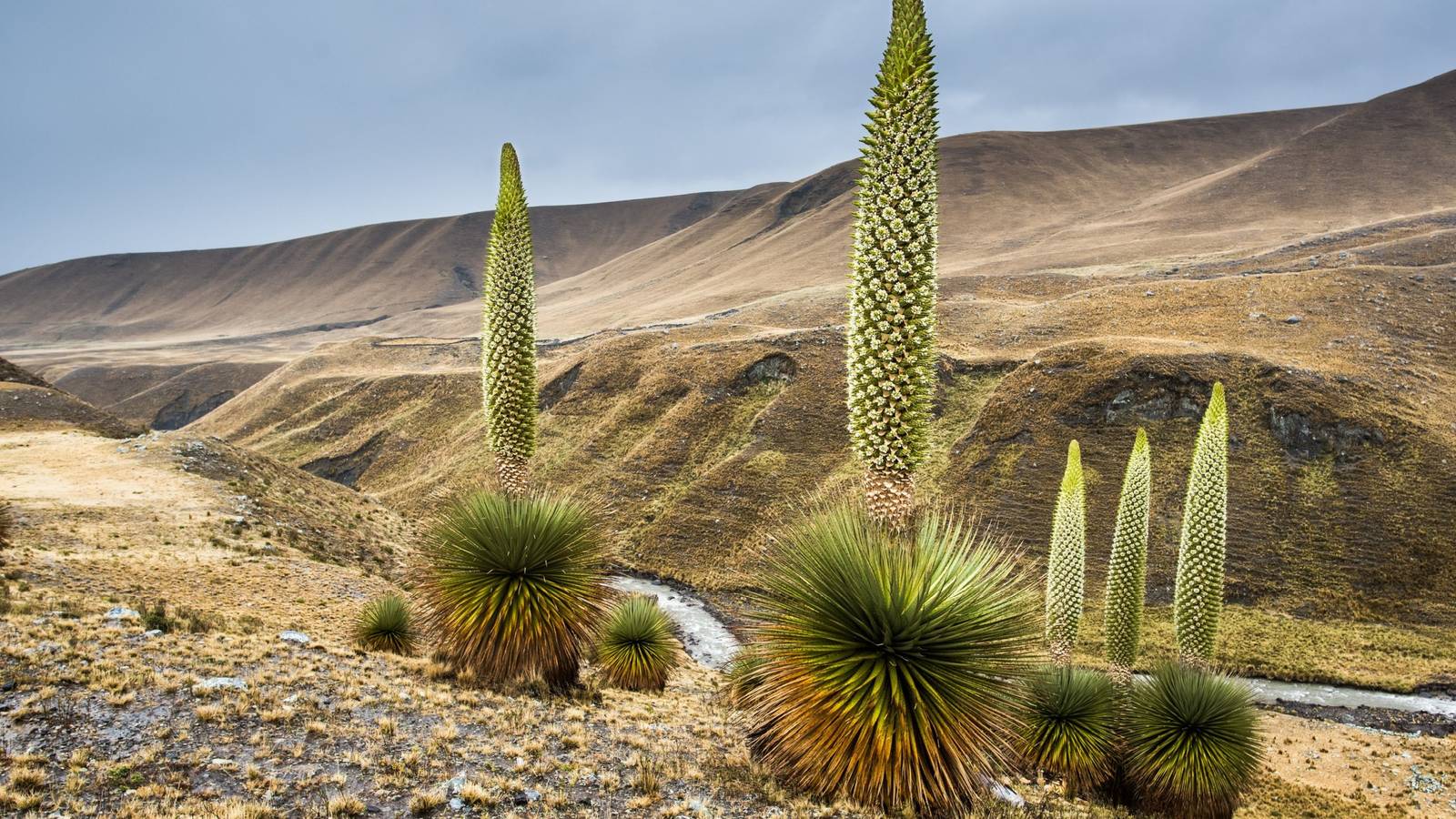
They are the ultimate one-hit wonders. Most plants flower every year. These wait a lifetime for one spectacular bloom, set seed, and die. Botanists call them *monocarpic* — from Greek 'mono' = one, ‘karpos’ = fruit.
It's not failure. It's strategy. Save every bit of energy for decades, then spend it all at once in a reproductive explosion that no annual flower can match.
*1. Bamboo — The 100-Year Mystery*
Most famous. A bamboo grove can live 40, 60, even 120 years as green stems, then suddenly _every_ plant of that species flowers at once — across continents — drops millions of seeds, and dies.
Why together? Predator satiation. Rats, birds can't eat _all_ seeds if millions fall at once. Some survive.
In India, _Melocanna baccifera_ — Muli bamboo in Mizoram, Manipur — flowers every 48 years. Last mass flowering 2006-07 triggered rat famine — _mautam_. Rats ate seeds, multiplied 100x, then ate crops. Famine. Next expected 2054.
Scientists still don't know how bamboo counts years. No rings. Theory: internal clock, day-length, epigenetic memory passed through rhizomes.
*2. Agave — Century Plant That Isn't A Century*
Agave americana, the Century Plant, actually blooms after 10-30 years, not 100. It sends up a 'quiote' — a stalk 6-9 metres tall, like a giant asparagus — in weeks, with thousands of yellow flowers. Bats, bees feast. Then the mother rosette dies, leaving pups at base.
Tequila is made from Blue Agave 'before' it flowers — farmers cut the stalk so sugars stay in the heart.
*3. Queen of the Andes — Puya raimondii*
Highest, rarest. Lives 80-100 years at 3,800-4,800m in Peru, Bolivia. Then grows a flower spike 10 metres tall — tallest inflorescence on Earth — with 8,000-20,000 flowers. Hummingbirds swarm. Then dies. Only 800,000 plants left, endangered by fire, grazing.
*4. Talipot Palm — Corypha umbraculifera*
Kerala's giant. Lives 30-80 years, grows 25m tall, leaves 5m wide — once used for manuscripts. Then produces the largest inflorescence in the world — 6-8m, with 'millions' of flowers, 1-2 million fruits. Then dies. Ola leaves still used for thatched roofs, fans in Kerala temples.
*5. Neelakurinji — Strobilanthes kunthiana*
Nilgiris' blue carpet. Flowers once every 12 years, then dies. Next bloom 2030 — last 2018 turned Munnar hills electric blue, 2.5 lakh tourists. Plant stores energy 12 years, then blooms synchronously to overwhelm seed predators and ensure cross-pollination.
Kurinji in Tamil Sangam literature — 12-year cycle gave Tamils their calendar, Murugan's flower.
*6. Other One-Shots*
- *Bromeliads:* Pineapple plant flowers once, fruits, dies — pups carry on.
- *Aeonium, Sempervivum:* Hen-and-chicks — mother rosette flowers once, dies, chicks live.
- *Annuals:* Technically monocarpic too — wheat, rice, marigold — live 1 season, flower once, die. But we mean long-lived perennials.
- *Titan Arum:* Not true monocarpic — Amorphophallus titanum blooms every 7-10 years, lives on in corm. Smells like rotting flesh to attract flies.
*Why Die After Flowering?*
Evolutionary trade-off. If you put all resources into seeds, you have nothing left for leaves, roots, defence. It's cheaper to die than try to recover. Also, death clears space, light for seedlings — mother becomes compost for her own babies.
In bamboo, dying grove lets seeds germinate in sunlight.
*Can We Stop It?*
Cutting flower stalk early can sometimes save agave, bromeliad — plant redirects energy to pups. But for bamboo, palm, Puya — once hormonal trigger fires, death is programmed. No cure.
*Why It Matters Now*
Climate change is desyncing flowering. Neelakurinji blooming early in some patches, bamboo flowering out of sync — rats, pollinators, local economies confused. If a species flowers once in 100 years and pollinators miss it, species can vanish in one season.
These plants teach patience. A bamboo shoot grows 1 metre a day for weeks, then waits 50 years to bloom. A human life is a blink to them.
Next time you see a century plant stalk in a Kolkata garden, or hear of Kurinji in 2030 — stop. You are watching a lifetime, spent in one week.
#Monocarpic #Bamboo #Neelakurinji #Agave #Puya #Talipot #Plants #Nature #Botany #Flowering