

NEW DELHI: A space domain awareness (SDA) analysis conducted by Bengaluru-based Digantara found that Chinese satellites carried out 37 pre-planned manoeuvres between 15 and 30 April 2025 that increased their passes over Pahalgam, departing from their usual orbital patterns. Scientists from the company said these manoeuvres were likely planned in advance of the attack.
The unusual activity began at least six days before the attack. On 16 April, the Yaogan-35 01A satellite altered its orbit, doubling the number of passes it made over Pahalgam. On the day of the attack, two other satellites, Yaogan-39 01B and Yaogan-39 01C, carried out manoeuvres at 5.14 pm and 5.59 pm, after the killings.
While the report does not establish the significance of these manoeuvres in relation to the attack, sources said the activity could indicate satellite monitoring of the area, potentially to track security force movements or assess escape routes for the terrorists. However, this remains an unverified hypothesis.
*What Digantara found:*
Digantara's analysis examined 1,332 Chinese space objects, of which 190 conducted at least one orbital manoeuvre during the assessment period.
Of those, 37 manoeuvres were flagged as unusual because they:
- Altered the satellites' regular orbital patterns
- Increased their coverage / passes over Pahalgam and surrounding areas in Jammu and Kashmir
- Appeared to be pre-planned, not routine station-keeping
A satellite manoeuvre is a controlled change in a satellite's orbit, direction, or speed that alters where and when it passes over Earth.
*The timeline:*
*April 16 — 6 days before attack:*
Yaogan-35 01A altered its orbit, doubling the number of passes it made over Pahalgam.
The satellite is officially associated with Earth observation but is believed to possess signals intelligence (SIGINT) and electronic intelligence (ELINT) capabilities.
Separately, China's Shijian-20 satellite altered its drift rate on April 16, changing its positioning relative to the southern Indian subcontinent and Indian Ocean.
*April 22 — Day of attack:*
At 5.14 pm, Yaogan-39 01B performed an orbital manoeuvre.
At 5.59 pm, Yaogan-39 01C performed an orbital manoeuvre.
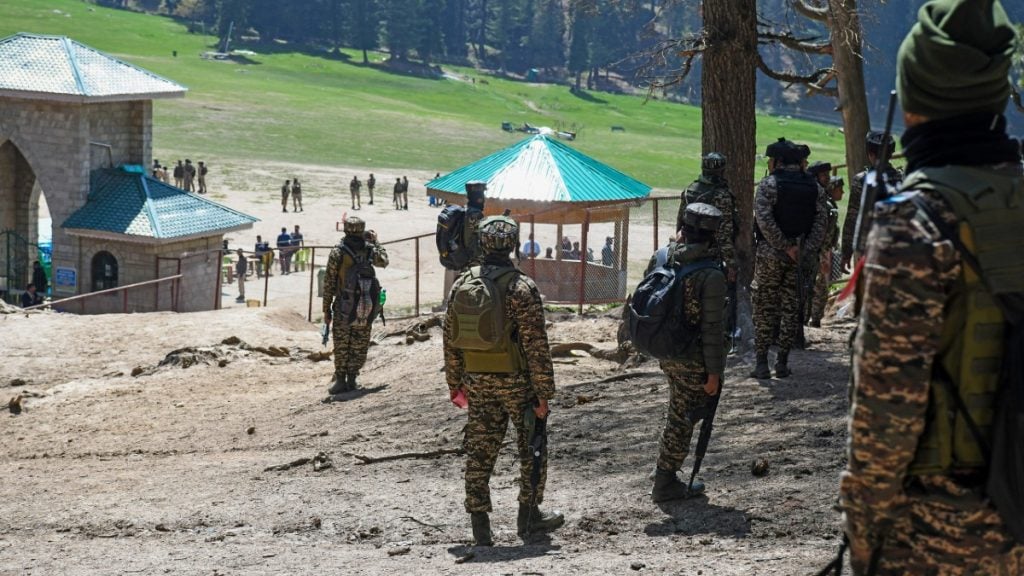
Both were roughly an hour after the attack in Baisaran meadow, Pahalgam, where 26 civilians — mostly tourists — were killed by terrorists belonging to The Resistance Front (TRF), an offshoot of Pakistan-based Lashkar-e-Taiba.
"Yaogan 39 01B and Yaogan 39 01C of the possible ELINT enabled Yaogan 39 01 triplet performed a maneuver on the day of attack with a resulting increase in number of passes over the AOI," the report read. AOI = Area of Interest.
*April 29-30 — Peak after attack:*
The manoeuvres peaked again on April 29 and April 30. On April 29, Chinese satellites from Low Earth Orbit (LEO) — ideal for a closer and sharper look at the selected area — conducted 37 manoeuvres and on April 30, conducted 31 manoeuvres.
This was during the period of heightened India-Pakistan tension after the attack, leading up to Operation Sindoor.
*What the satellites can do:*
These satellites are equipped with advanced imaging and surveillance technology, which can be used for military reconnaissance and intelligence gathering.
- *Yaogan-35 series:* Officially Earth observation, but analysts associate several satellites in the broader Yaogan network with military intelligence and surveillance.
- *Yaogan-39 series:* Believed to be ELINT-enabled — capable of picking up electronic signals, radar emissions, and communications activity.
- *LEO satellites:* Orbit closer to Earth, giving sharper images and more frequent revisits over a specific area.
High-resolution imagery, radar, and signals intelligence can reveal troop movements, security force deployments, and electronic activity — which is why increased surveillance over a sensitive region demands scrutiny.
*What it does NOT prove:*
The report is careful on this point, and so are Digantara's scientists:
- It does *not* establish whether the movements were connected to the terrorist attack
- It does *not* prove whether any intelligence was shared with other parties, including Pakistan
- It does *not* prove Chinese involvement in planning the attack
According to the Digantara report cited by ThePrint, the orbital changes _could_ suggest intelligence collection or strategic monitoring. However, the analysis does not establish a direct link.
Sources from Digantara's surveillance team told ThePrint that the activity could indicate satellite monitoring of the area, potentially to track security force movements or assess escape routes for the terrorists. However, this remains an unverified hypothesis.
*Why this matters — the wider pattern:*
This is not the first time satellite activity around Pahalgam has raised questions.
A month after the terrorist attack, ThePrint did a series of exclusive stories which confirmed how requests for satellite images of the Pahalgam region shot up weeks before the attack from a US-based satellite company — raising the possibility that they were used to plan the attacks and the subsequent escape of the terrorists.
ThePrint also reported how Pakistan revived its satellite programme in 2025, launching six satellites over 16 months between January 2025 and June 2026. Five of these launches were conducted with Chinese assistance.
Together, the three threads — commercial imagery requests, Pakistan's Chinese-assisted satellite launches, and now Chinese satellites' unusual manoeuvres — paint a picture of intense space-based attention on Pahalgam before and after April 22, 2025.
*What India must do next:*
Space domain awareness — tracking what satellites are doing, not just where they are — is becoming critical for national security. Digantara's analysis shows India can now detect when a foreign satellite suddenly starts paying unusual attention to a sensitive area.
The question for Indian agencies is whether this pattern was a coincidence, routine repositioning, or deliberate surveillance — and if it was deliberate, who benefited from the data.
As of now, there is no official response from China or Pakistan on the Digantara findings.
#Pahalgam #China #Satellite #Yaogan #Digantara #ThePrint #JammuKashmir #TerrorAttack #Space #Surveillance