

MEXICO CITY: When workers began building the Felipe Ángeles International Airport north of Mexico City, they expected concrete, not Ice Age giants.
Instead, they uncovered a bone bed of about 700 mammoths, 200 camels and 100 horses. And among them, in 2021, archaeologist Israel Peña found something even rarer — a human.
He first thought the dark bones belonged to a prehistoric camel. They were the same size, the same black-brown colour from the swampy sediment. As the excavation expanded in a 25 by 30 metre area, the team realised the truth: it was a man.
Mexico's National Institute of Anthropology and History (INAH) named him Yotzin — from the Nahuatl word meaning "unique". On November 20, 2026, INAH announced his age. He is one of the oldest known human remains from the Basin of Mexico.
Two independent labs dated a sample from his third molar — his wisdom tooth. Collagen analysis by ISOTOPIQ AGING in Belgium gave 13,087 to 12,987 years before present. Bioapatite analysis at the University of Georgia gave 12,050 to 11,700 years before present.
Together, INAH presents it as 13,087 to 11,700 years ago — the end of the Pleistocene and the start of the Holocene, when mammoths still roamed and humans were establishing themselves across the Americas.
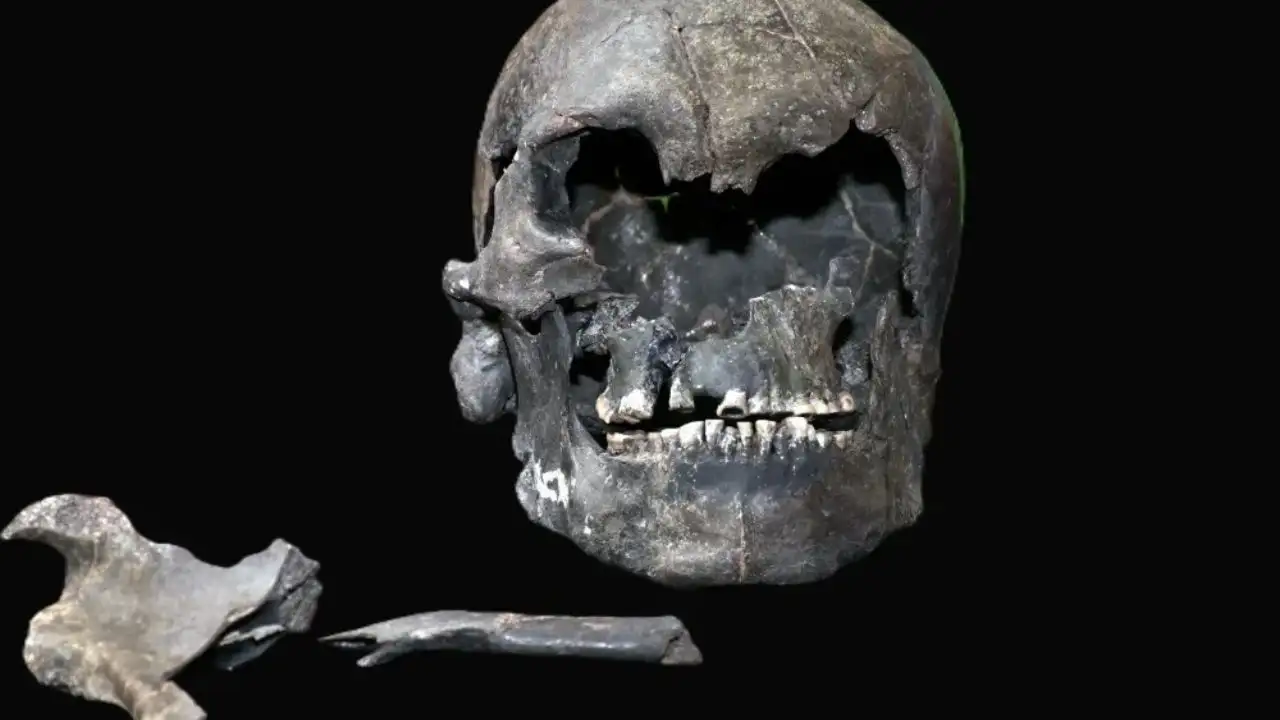
Yotzin was 80% complete, including a partial skull with a fracture around the nose and left eye. He was a man between 25 and 30 years old when he died, standing about 1.75 metres tall — unusually tall for the time, when most people in the region measured 1.60 to 1.65 metres.
His bones were dense, his thigh and shin bones flattened, his teeth heavily worn but with no cavities. INAH's physical anthropologist Arturo Talavera González links that to an intensely active life: long walks, hard diet, using teeth as tools — a preceramic hunter-gatherer before farming.
He was found in Stratigraphic Unit IV, a silty Solonchak layer from an ancient marsh — the bed of former Lake Xaltocan. He lay flexed on his left side. There were no burial offerings, no artefacts, no intentional grave. He was the only human in that area.
Talavera has a dramatic hypothesis: Yotzin was struck by a mammoth, thrown eight metres, and died trying to get up. A mammoth was found eight metres away. It is a hypothesis, not proof — but it captures how close humans and megafauna lived.
The discovery is important because it is well-documented. Unlike the famous Tepexpan Man, found in 1947 and once thought to be 10,000 years old but later doubted, Yotzin was recovered in a controlled excavation, with full context.
His skull is elongated, reminiscent of northern Mexican groups like the Pericúes of Baja California — a clue that early populations may have been more diverse than textbooks suggest.
Genomic testing is now underway at the University of Burgos in Spain, with results expected in early 2027. That DNA could reveal where Yotzin's people came from, and how they relate to later Native American populations.
For now, Yotzin stands as a bridge: a man who walked among mammoths, died in a marsh, and was buried by time — until an airport brought him back to light.
*Tags:*
#Yotzin #Mexico #Archaeology #Mammoth #IceAge #INAH #AncientHistory #Americas #Fossil #HumanOrigins