

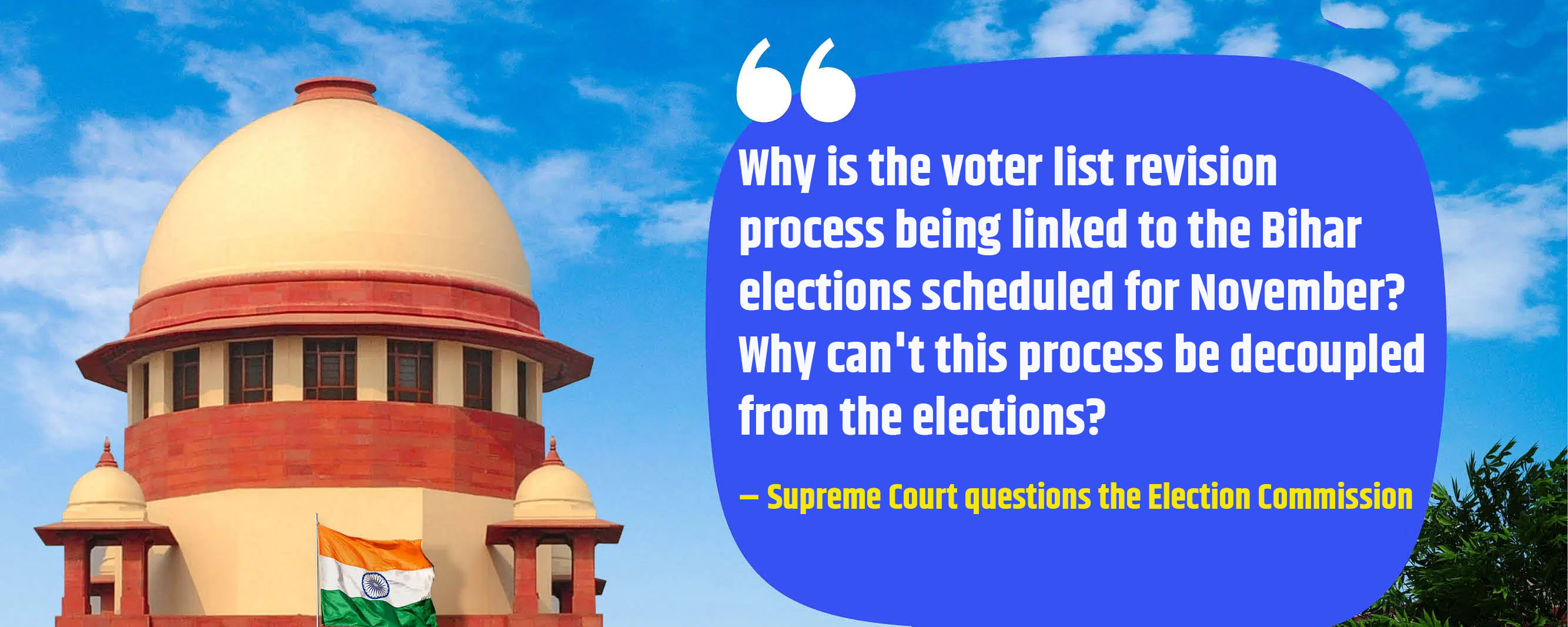
The Supreme Court’s hearing on Bihar’s Special Intensive Revision (SIR) of the electoral roll has become more than a legal proceeding—it has emerged as a test of the balance between electoral reform and political intent in Indian democracy. The Election Commission’s (ECI) decision in June 2025 to reverify over 30 million voters in Bihar—just months before the state assembly elections—has sparked national debate and criticism. In a democracy that prides itself on universal suffrage, this is no minor storm.
According to the ECI, the revision was necessary due to rapid urbanization, migration, and poor documentation in Bihar. But the way this process has been implemented has raised serious concerns. Voters who registered after 2003 are now required to resubmit proof of citizenship and residence—including birth certificates, parental documents, and more. Strikingly, common documents such as Aadhaar cards and ration cards were initially excluded from the list of accepted IDs.
But on July 10, the Supreme Court stepped in with key directives. After a prolonged hearing, the court instructed the Election Commission to consider accepting Aadhaar cards, ration cards, and voter ID cards as valid proof for verification. More importantly, it asked the ECI to respond to three crucial questions:
- Why is the revision process being directly linked to the upcoming November elections in Bihar?
- Why is citizenship verification being made part of this process, when it falls under the Ministry of Home Affairs?
- Is the process inadvertently or deliberately targeting specific voter groups?
“Why are you linking this to the Bihar elections?” the bench asked bluntly. Justice Joymalya Bagchi observed that the voter list revision could very well be a nationwide, apolitical process. She added that identifying non-citizens in the voter list isn’t inherently wrong—but such intensive scrutiny should have taken place before the elections were announced.
The Supreme Court has not stayed the revision process—largely because the petitioners did not seek an interim stay. However, the Court made it clear that while it would not stop a constitutional institution like the Election Commission from performing its duties, it would still hold it accountable. The bench of Justices Sudhanshu Dhulia and Joymalya Bagchi has given the ECI one week to submit an affidavit, and the petitioners another week after that to respond. The next hearing is scheduled for July 28.
Opposition parties—including RJD, Congress, and the Trinamool Congress—have alleged that the revision drive is a veiled attempt by the BJP-NDA to suppress votes. They claim that the verification process disproportionately affects communities that traditionally vote for the opposition: migrant workers, Dalits, Muslims, and the rural poor. The BJP, on the other hand, insists that this is a routine administrative measure, not a political maneuver.
At the heart of the storm is Bihar’s Seemanchal region—bordering Nepal and Bangladesh—where the rhetoric of “illegal infiltrators” has re-emerged. Critics are comparing the situation to Assam’s controversial NRC (National Register of Citizens), which excluded over 1.9 million people from the citizenship list. The fear now is: Is Bihar heading down the same path, this time under the cover of election readiness?
The Supreme Court now faces a pivotal choice: Does the Election Commission’s move uphold the principles of Articles 14, 21, and 326 of the Indian Constitution—or does it violate them through arbitrary exclusions that threaten fundamental rights? The coming weeks will reveal the court’s stand.
This controversy is not just legal—it is also a test of public trust in India's democratic institutions. The same voter list that was declared final by the ECI in January 2025 is now being revised without clear, transparent data. This calls into question the neutrality and timing of the Commission’s actions.
What happens next will shape more than just the November elections in Bihar. It will set a precedent for how India’s democracy handles the tension between voter integrity and voter inclusion. It will ask whether, in the face of political pressure, institutions like the judiciary, the Election Commission, and the administrative machinery can remain independent, fair, and rights-focused.
Efficiency without transparency is dangerous. Reform without consultation creates exclusion. The Supreme Court’s decision will not only determine the fate of a voter list—it will redefine what electoral sanctity means in India, not just in principle, but in practice.
Riya Goyal is a trainee journalist at Cult Current. The views expressed in the article are
her ownand do not necessarily reflect the official stance of Cult Current.