

Pune's Progressive Legacy and Modern Aspirations
Pune has its own distinct character. This city has been the centre of Maratha renaissance under the Peshwas and has for decades remained a source of education, culture and art. Pune's identity has been marked by its middle-class work ethic and the freedom afforded to women. Compared to other cities in India, women here demonstrated self-reliance and independence much earlier, where women of all ages can be seen on the roads on two-wheelers. But along with this progressiveness, Pune is also firmly rooted to its origins. It has been the land of Hindutva icons like Savarkar, who studied at Fergusson College and spent time in Yerwada Jail. Today's Pune, on one hand, preserves the legacy of Savarkar and the Peshwas, and on the other, has emerged as a global power in the field of electronics and Information Technology [IT]. In such a city, Rahul Gandhi's attack on patriarchy and Manusmriti and the ABVP's gambit of nationalism through Vande Mataram has sparked a new debate among the educated and aware youth here.
The New Front of the National Song and Appeasement
The ABVP used this event in Pune like a mirror for the Congress. Despite a law passed during the recent Monsoon Session of Parliament, the BJP adopted an aggressive stance over the Congress not singing all six stanzas of Vande Mataram. Home Minister Amit Shah linked this issue directly to 'cultural nationalism' and launched a scathing attack on the Congress. Shah alleged that the Congress's decision in 1937 to limit the stanzas of Vande Mataram was a result of bowing down to the Muslim League and that it is still part of the same old policy of minority appeasement. Shah's argument reinforces the larger discourse of the BJP where they talk of a clear and fearless nationalism on issues like Savarkar, Article 370 and military action against Pakistan-sponsored terrorism. The BJP has caught on to that weakness of the Congress where the Congress maintains silence over the discomfort caused to a particular section by the "religious" vocabulary of the national song.
The New Grammar of Discontent: CJP and the Student Movement
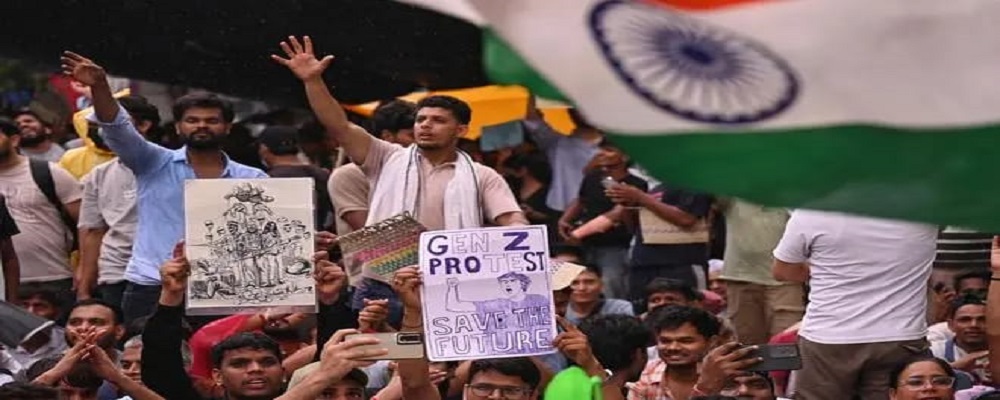
After the Lok Sabha elections of June 2024, where the BJP had to return to power with a reduced majority, the first major challenge before the government emerged in the form of the 'Cockroach Janata Party' [CJP]. Allegations of paper leaks in crucial public examinations like NEET [National Eligibility cum Entrance Test] created massive resentment among students. This protest that began at Delhi's Jantar Mantar and the fast by Ladakh activist Sonam Wangchuk quickly became the centre of student anger. The activism of left-wing student organizations not only gave organizational strength to this movement but also marked a presence on the streets that seemed to pose a tough challenge to the Modi government's power.
Rahul Gandhi's interaction with students in Pune is an attempt to encash this very youth discontent. Rahul is now trying to make inroads among those students who are troubled by irregularities in examinations and lack of jobs. This is a well-thought-out strategy to reach 'Generation Z' [Gen Z]. However, in this path, Rahul's challenge is not only the BJP, but also those new political players who are sidelining established parties. The activism of actor Vijay in Tamil Nadu and Prashant Kishor's Jan Suraaj Party in Bihar is indicating that today's youth is not only looking towards the traditional opposition, but is also in search of new and non-traditional leadership.
Repetition of Strategy: From Rafale to NEET
Rahul Gandhi's strategy for the last few years has been running on the same track - to make a direct and personal attack on Narendra Modi. In the 2019 elections, the slogan of "Chowkidar Chor Hai" over the Rafale deal and claims of loss to HAL [Hindustan Aeronautics Limited] had shaped the Congress's campaign. However, the Supreme Court's verdict and the people's mandate had outright rejected those allegations, but Rahul did not change his strategy. After Rafale, he is now attacking the Prime Minister's "credibility" through NEET and other allegations of corruption. The Congress believes that if the Prime Minister's spotless image can be tarnished, it will be easier to demolish the fortress of the BJP.
But there is a big catch here. The Congress often underestimates that strong welfare mechanism of the BJP which has directly benefited crores of people. Schemes like Ujjwala Yojana, free ration, pucca houses and cards like Ayushman Bharat have built such a credibility for Modi among the poor that is difficult to break with mere political slogans. Rahul's call of "Mohabbat Ki Dukaan" and "Pune Manje Prem" [Pune means Love] still seems to be struggling in front of this welfarist and protective nationalism.
The Return of Mandal and Social Equations
Rahul Gandhi has once again taken recourse to "Mandal" politics to break the BJP's broad Hindu coalition. He is raising the issue of caste representation in bureaucracy and the private sector and claiming that "90 percent" of the country's population [Dalits, tribals, backward classes and the poor] is outside the system. His demand for a "Rohit Vemula Act" and insistence on representation in proportion to population is an attempt to attract a section that feels left behind in the race for development.
However, this strategy is a double-edged sword. Rahul's tough stance on caste reservation and representation can distance the upper classes from the Congress. In response, the BJP has played the card of "Sarva Samaj" and "Antyodaya". Schemes like 'PM Vishwakarma' which are specifically for artisans from backward classes are part of that strategy of the BJP where it links caste identity with development and self-reliance. Modi's pledge of "Viksit Bharat" on one hand ignites aspirations, while on the other hand it talks of a unified Indian identity instead of caste division.
Youth Dialogue: Experience vs Aspiration
Despite being much older than Rahul Gandhi in age, Narendra Modi has built a unique connect with young voters. Through 'Pariksha Pe Charcha', regular meetings with startups and interactions with sportspersons, he presents himself as a mentor who talks about excellence. The BJP's strategy is to give the youth "opportunity" and "skill", while the Congress is making them aware of their "rights" and "injustice". In an educational hub like Pune, these two discourses are face to face. On one side are those youth who are angry due to paper leaks and unemployment, and on the other side are those who see themselves in the dreams of space-tech, digitalization and a Global India.
Student protests and rallies on the streets of Pune show that India's youth is no longer just a silent spectator. The gap between urban life, income and aspirations is real and from time to time it erupts as anger in places like Noida or Manesar. The Congress wants to make this very restless section its new political base. But the challenge is that 'Generation Z' is not a group with a uniform mindset. It is connected with technology, is ambitious and often prioritizes results over ideology.
Conclusion: The Battle of Sovereignty and Identity
This political spectacle of Pune is just a small glimpse of many upcoming assembly and Lok Sabha elections. Rahul Gandhi's 'patriarchy' and the BJP's 'nationalism' on the 'complete' Vande Mataram - these are imaginations of two different Indias. Where the BJP talks of a culturally assertive and economically self-reliant India, the Congress is demanding a system that is more inclusive and where caste and gender equality are at the centre.
The outcome of the elections in 2027 and beyond will depend on which party is able to resolve this dilemma in the minds of the youth. Will Rahul's Mandal card and message of love outweigh Modi's welfarist nationalism and pledge of Viksit Bharat? Pune has prepared the ground for this war. Here, the real decision between the 'Echo of Students' and the 'Voice of Youth' lies in the hands of that 'Generation Z' which on one hand wants to preserve its roots and culture, and on the other, is in search of a modern and just future.