

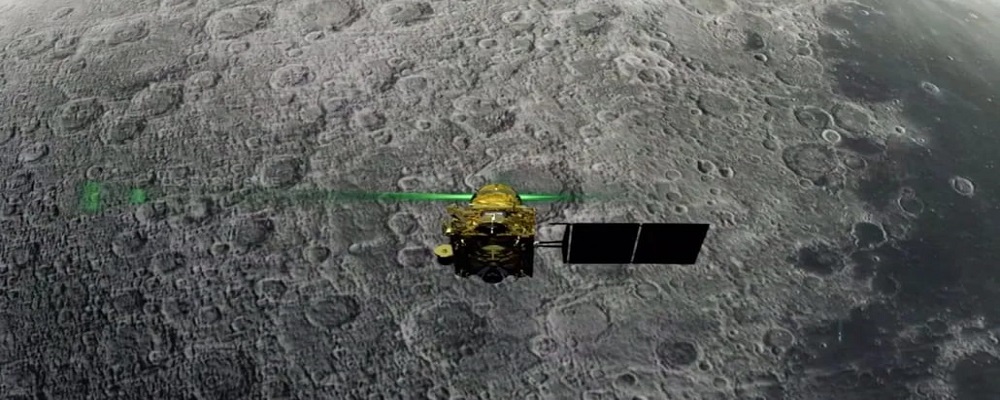
For the first time, planetary scientists have confirmed the existence of a hidden impact crater on the lunar surface using mineralogical data obtained from Chandrayaan-1 — and it could be the oldest known impact basin on the Moon.
A team of researchers from the Physical Research Laboratory (PRL), Ahmedabad, has identified the Australe Basin, which had remained untraced as this ancient basin suffered erosion along its rims, making it extremely difficult even for modern-day imaging techniques to detect.
Scientists believe there are approximately 300 impact basins present on the Moon. Of these, only 74 have been detected so far. Impact basins are formed over the lunar surface due to various violent space activities, like asteroid or meteorite hits. These are large craters, often several hundreds of kilometres in diameter, and can have distinct outer rims. Due to the space hits, these craters are often found with remnants of volcanic activities.
This study, published in ‘The Planetary Science Journal’, has shed light on one such impact basin confirmed to be located along the south-eastern hemisphere of the Moon. It has distinct morphology and gravity signatures and some unique mineralogical compositions.
PRL scientists are also of the opinion that this basin could well be older than the South Pole Aitken Basin which is the largest and the oldest known basin on the Moon, formed over 4 billion years ago.
Neha Panwar, planetary scientist and lead author of the study, said, "The volcanism inside the Australe Basin has a very unique mineralogy. Unlike the majority of basalts on the Moon that are high in calcium bearing, these basalts are relatively lower in calcium and higher in magnesium."
Moreover, the Australe Basin was found to be in a province characterized by 248 small basalt ponds arranged in a circular pattern unlike several of the previously known impact basins that are classified for their smooth and vast hardened lava surfaces.
The mineralogy of the Australe Basin was detected using data gathered by the Moon Mineralogy Mapper of NASA. It is an imaging spectrometer that was designed to create mineralogical map of the lunar surface. It operates between 405 and 3000 nanometre wavelength range. There were 11 scientific payloads onboard the Chandrayaan-1. Of these, six were contributions from international space agencies including National Aeronautics Space Administration (NASA) and the European Space Agency.
Scientists studied the absorption bands exhibited by some of the key lunar minerals, such as pyroxenes, olivine, and plagioclase.
PRL scientists noted that even the Chandrayaan-3 landing site, now known as the Shiv Shakti point, possessed higher concentrations of magnesium. And that could be linked to some material originally from the South Pole Aitken Basin to have gotten transported to the Shiv Shakti point, located approximately 350 km apart.
"Interestingly, what we found was that the Australe region, too, has widespread Magnesium-bearing lithologies. Since the region lies close to the Moon's South Polar region, it is likely that the material excavated by this impact would also have been deposited across the South Pole. With the future missions planned in the South Polar Region, it is important to understand how the regolith in these regions has evolved over billions of years," she explained.
If South Pole-Aitken was thought to be the first chapter of the Moon's violent history, Australe pushes the prologue back even further — beyond 4 billion years. The discovery matters for two reasons. First, it explains a long-standing anomaly: why Shiv Shakti point, where Chandrayaan-3 landed, shows magnesium enrichment despite being far from known magnesian sources. Second, with NASA's Artemis and ISRO's LUPEX eyeing the South Pole for a base, knowing that Australe's ejecta blankets the region changes how we will read the regolith samples.
It is also a quiet vindication of Chandrayaan-1. Launched in 2008 with a mission life of two years, its M3 instrument is still producing discoveries 17 years later that modern orbiters missed because they looked for shape, not composition.