

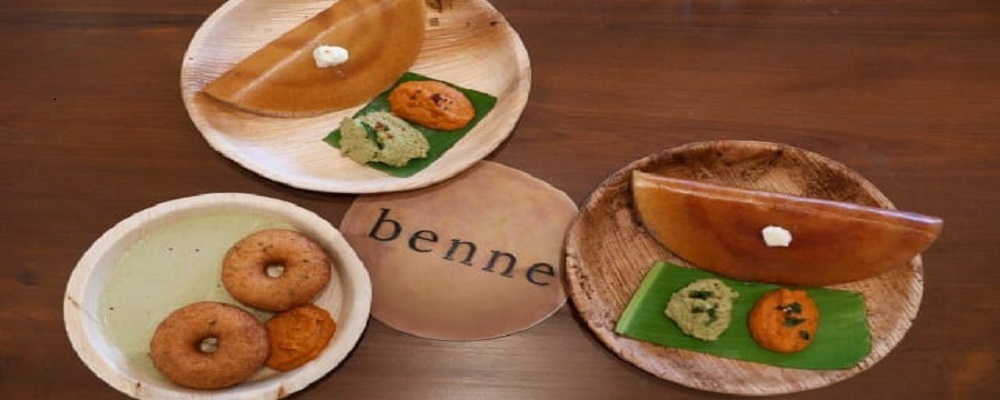
IT'S A weekday evening. Around 12 people are waiting at Bene, an eatery in Greater Kailash I. Zomato shows the wait is exhausting and thus it does not exhaust the customers. "I like that I don't have to think a lot after coming here. I know it's Bene Dosa," says Kavya, a student at Delhi University.
Bene means butter. The eatery gives customers three variations of butter dosa, along with accompaniments like chutney, sambar and idli and filter coffee.
Aditya Vaida, Head of Development at Bene, says, "Feel that the restaurants that have a relatively smaller menu tend to serve better food... If you have 50 items on the menu, the customer's attention gets divided."
Along with her husband, Priyamvada Gupta co-founded Domino's, a specialty sandwich eatery chain, last year with her husband Prateek Gupta — because I'm otherwise going to spend 20 minutes on what's the best thing that I want to order, the vibe at the cafe, according to the menu.
Similarly, Akhil co-founded Dough & Darshini's in Karnataka — a small fast-food eateries with only stand-and-eat options. "We have a modern touch to a Tarshini'. But we're still essentially dining restaurants but Dumbo — that has three outlets across Delhi, serving Italian Florentine schiacciata sandwiches with an all-vegetarian options — was no less than a passion project.
Nuttakorn Ngam Flo-rence, Italy, where they have these sandwich shops (deli) that have an exactly similar concept — you go there and quickly grab and go," he explains.
Lotli Priyamvada Gupta at Dumbo's limited options of Dosas, a 'Dambuli', said a restaurateur in Maharashtra's Sangli-born chef in Mumbai's Bene, highlights the benefits of having a limited menu, "For serving tasty items, you must can't be an option. We have chosen efficiency over variety. Gupta agrees, "It's easier to do 10 things well than 30."
The Khou Suey Shop and Ti's Timsu also have just one item to offer. The Khou Suey Shop and Ti's Timsu also have just one item to offer. Soumya Fafadia of Safdarjung, where almost every restaurant serves a variety of Chinese, Malay, Japanese, Thai, Vietnamese, Korean cuisine, sits many chicken, momos, cap-tain chicken, vegetarian, vegetarian laphings.
Gupta in April this year, which works on 'pay what you want model', is a hole-in-the-wall coffee place in the capital. They offer 9 coffee varieties. Aaj, the founder and barista says, "People have too many options. This is what has become of our cafe culture. I want people to come only for coffee and pay what they feel that they are present for the moment."
People don't know what they want, but you give them fewer options, they make up their minds faster. Less is more," he adds. The idea followed by these founders, during founder of Nastaas, an AI-powered foresight and trend-spoke, eighth form, and Sara Roversi, Founder and President of the Future Food Institute, spoke of the 'exhausted eater'.
"An exhausted eater is one who, when even the act of deciding what to eat is overwhelming. This directly points to the menu options that exist. Earlier, if you wanted to have multiple cuisines when you went to a restaurant, it was variety. People wanted that huge palette to decide from, variety is the spice of life. But in today's day and time, we see a huge clampdown, according to Nextatlas' analysis, conversations in the F&B industry concerning decision fatigue are rising - a sharp increase of 114% over the past year. This is one of the pressing cultural shifts that is shaping appetite today," said Moreno.
Delhi's 114% spike in 'choice exhaustion' talk is real. Swiggy and Zomato trained us to scroll 200 items. Now restaurants are doing the opposite — Bene's 3 dosas, Dumbo's schiacciata, one-dish Khou Suey. It's operational brilliance: smaller inventory, faster table turnover, better quality control. And it's psychological: in a decision-fatigued economy, curation is the new luxury. Less menu, more memory.