

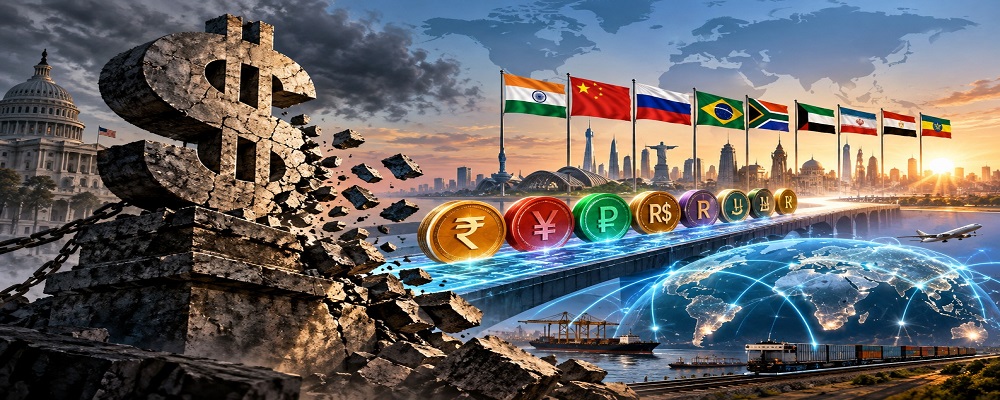
When the 18th BRICS Summit drew to a close at the magnificent Bharat Mandapam in New Delhi on September 12–13, 2026, it was more than another gathering of emerging economies. Beneath the ceremonial diplomacy and carefully crafted communiqués was a quieter tremor—the possibility that the era of unchallenged financial unipolarity may finally be entering its twilight.
The ink on the New Delhi Declaration was barely dry when a new phrase began to reverberate across diplomatic and financial circles: BRICS Pay.
Built around the idea of digital public infrastructure, BRICS Pay represents an attempt to construct an alternative financial pathway—one that could put a dent in the dominance of the US dollar, a currency whose reach has long appeared almost impregnable.
The dollar story, however, is no longer merely a story about American power. Increasingly, it is becoming a story about financial autonomy, economic choice and the aspirations of the Global South.
The Dollar: Global King or Financial Golden Cage?
To understand the significance of BRICS Pay, one must first understand the extraordinary spell cast by the dollar over the global economy.
The dollar is not merely a currency. It is the operating language of international commerce—the lubricant that keeps global trade, finance and reserves moving. For decades, its deep liquidity, convertibility and institutional credibility have made it the preferred currency for trade settlements, international borrowing and central-bank reserves.
According to International Monetary Fund data for the first quarter of 2026, the US dollar still accounted for 57.13 percent of global foreign-exchange reserves. Its depth and liquidity continue to make it the default safe-haven asset for central banks across the world.
Yet the very strength of the dollar has also created a paradox.
The global financial architecture built around it has given Washington extraordinary structural influence. The financial crisis of 2008 reinforced a growing concern among both developed and developing economies: should such a substantial degree of monetary and financial leverage rest, directly or indirectly, within the orbit of a handful of Western institutions?
The dollar, chosen largely for convenience and efficiency, can at times become what might be called a financial Bhasmasura—a source of power capable of producing consequences far beyond the intentions of any single economy.
A decision taken in Washington can reverberate through commodity prices in Asia, debt markets in Africa, food bills in developing countries and the purchasing power of households thousands of miles away.
That is where the debate over de-dollarization acquires a significance far greater than currency mechanics.
BRICS: From Goldman Sachs Projection to Global Platform
The history of BRICS is, in many ways, the story of an economic hypothesis gradually acquiring geopolitical substance.
In 2001, Goldman Sachs economist Jim O’Neill coined the term BRIC to describe Brazil, Russia, India and China—the emerging economies he believed would play an increasingly consequential role in the global economy.
What began as an investment thesis acquired political form in 2009, when the four countries held their first formal summit in Yekaterinburg, Russia.
Since then, BRICS has expanded into a considerably broader grouping. Today, with 11 member countries, it represents nearly half of the world's population and around 40 percent of global GDP measured at purchasing power parity.
Its evolution reflects a larger transformation: emerging economies are no longer content merely to participate in institutions designed elsewhere. They increasingly seek a greater role in shaping the rules, platforms and financial mechanisms of the international system.
The New Delhi summit added another layer to this evolution.
Under Prime Minister Narendra Modi's chairmanship, the summit sought to reinforce the political voice of the Global South and promote greater use of national currencies in cross-border trade.
For India, the issue has particular strategic relevance. Efforts to diversify crude-oil settlement mechanisms and expand local-currency trade point towards a broader ambition: reducing unnecessary dependence on a third-country currency for transactions that do not inherently require it.
For the dollar-centric system, that is less a declaration of war than a wake-up call.
BRICS Pay: Cutting Out the Middleman
BRICS Pay is not simply another payment application. Its larger significance lies in the possibility of reducing the dollar's role as an intermediary currency in cross-border transactions.
For decades, the conventional architecture of international trade has often required transactions between two non-dollar economies to pass through the dollar at some stage.
Consider a simple example. If India buys Russian oil, or Brazil sells agricultural commodities to China, the underlying commercial relationship does not inherently require the US dollar. Yet the global financial system has historically made dollar-based settlement one of the easiest and most widely accepted routes.
That intermediary role creates demand for the dollar—and, consequently, reinforces its centrality.
BRICS Pay seeks to alter that equation.
The concept is to create a digital public infrastructure through which participating countries can facilitate cross-border payments using their national currencies, rather than automatically routing transactions through the dollar.
If large volumes of trade begin to move directly through the rupee, yuan, riyal, ruble and other national currencies, the implications could extend well beyond transaction costs. Over time, it could reduce structural demand for the dollar in precisely those areas where it has traditionally enjoyed an almost automatic advantage.
India has already experimented with local-currency settlement mechanisms, including arrangements involving Russia and the United Arab Emirates.
The significance lies not in any single transaction, but in the cumulative effect.
De-dollarization, after all, is unlikely to arrive as a dramatic overnight event. It is more likely to emerge through thousands of incremental decisions—one trade settlement, one banking arrangement and one digital payment platform at a time.
The New Development Bank: Another Pillar of Financial Sovereignty
The BRICS financial architecture does not end with payments.
At its centre stands the New Development Bank (NDB), established by the BRICS countries as an institution focused on infrastructure and sustainable development financing.
Its emergence reflects a broader desire among developing economies to diversify their sources of development finance and reduce excessive dependence on traditional Western-led institutions.
One of the NDB's potentially significant contributions is its ability to support financing in local currencies.
For developing economies, this matters.
Borrowing predominantly in a foreign currency can expose a country to exchange-rate volatility and to monetary-policy decisions taken elsewhere. When the US Federal Reserve raises interest rates, for instance, the consequences can travel far beyond American borders—affecting capital flows, borrowing costs, currency values and debt sustainability across emerging markets.
Local-currency financing cannot eliminate these risks. But it can provide another layer of resilience.
That is precisely where the broader BRICS project acquires strategic depth. The objective is not necessarily to replace one financial hegemon with another, but to create multiple avenues through which countries can trade, borrow and settle accounts.
The Power of Repetition
Sceptics are bound to ask a legitimate question: can a digital payment system really undermine the global dominance of the dollar?
The answer may lie in an old Indian couplet:
“Practice makes even the dull-minded wise;
as the rope wears away the stone through repeated rubbing.”
The metaphor is remarkably apt.
BRICS Pay is the rope. The dollar-centric financial architecture is the stone.
No single payment platform can shatter a system that has been built over decades. The dollar possesses enormous advantages—deep capital markets, global liquidity, institutional familiarity, convertibility and network effects that cannot simply be replicated overnight.
But systems do not always change through spectacular revolutions.
Sometimes they change through repetition.
One alternative payment channel becomes two. Two become ten. Local-currency settlements become routine rather than exceptional. Businesses learn to operate outside traditional financial pathways. Banks build interoperability. Digital infrastructure lowers transaction barriers.
And gradually, the old architecture begins to acquire competitors.
That is the real significance of BRICS Pay.
The dollar may remain the king player for a long time. But BRICS is making a different argument: the world does not need to abandon the dollar in order to reduce its dependence on it.
From Delhi to a Multipolar Financial Future
For India, the 18th BRICS Summit represented an important moment in the continuing debate over the future of global finance.
New Delhi's message was not simply about challenging the dollar. It was about expanding the range of choices available to developing economies.
The emerging financial order may therefore be less about the collapse of one currency and more about the gradual multiplication of alternatives.
The dollar's empire will not disappear in a day. Nor is BRICS Pay, by itself, capable of dismantling a financial architecture that rests upon decades of accumulated trust, liquidity and network effects.
But the first crack in an old structure rarely announces itself with thunder.
Sometimes it arrives quietly—in a line of code, a cross-border transaction or a payment settled in a currency other than the dollar.
The torch lit for BRICS Pay in New Delhi may therefore prove significant not because it immediately dethrones the dollar, but because it begins to normalise the idea that the global economy can function through more than one financial centre of gravity.
And when historians eventually look back at this period, they may find that the transition towards financial multipolarity did not begin with a currency war.
It began with an alternative.
The next great story of the 21st-century financial order may not be the end of the dollar—but the end of its unquestioned exclusivity.
The author is an expert in economic affairs. The views expressed in this article are her own and do not necessarily reflect those of the publication.