

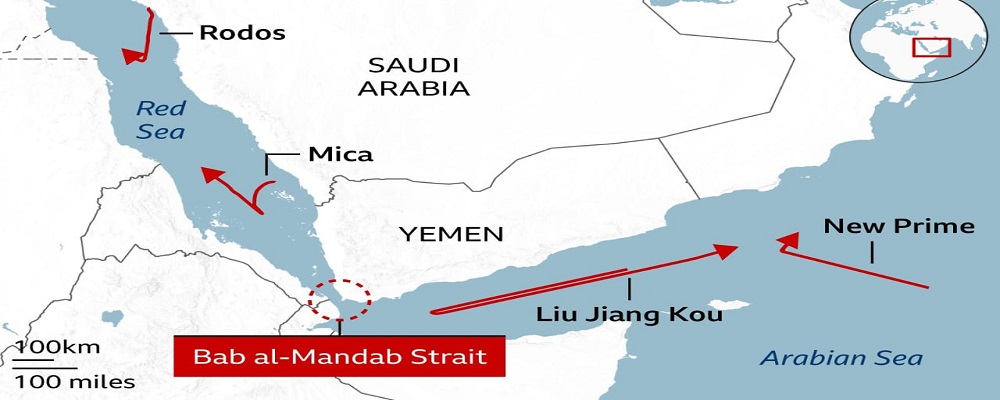
YEMEN'S CIVIL war, which commenced in the aftermath of the Arab Spring, has flared up with renewed intensity. The latest Houthi offensives have resulted in their control of the Red Sea coast of Yemen and the Bab el-Mandeb Strait — the sole gateway between the Red Sea and the Gulf of Aden, providing access to the Suez Canal from the Arabian Sea, carrying roughly 12 per cent of global trade. While the Houthis have threatened the waterway with long-range weapons in recent years, occupying Perim Island gives them an unobstructed line of sight over commercial traffic.
After Saudi fighter jets attacked and damaged the Sana'a airport runway in Yemen to prevent an Iranian plane from landing without clearance, the Houthis declared a naval blockade of Saudi Arabia, followed by regular attacks on Saudi tankers in the Red Sea as well as its oil-related facilities. The lack of support from Saudi-backed forces for UAE-aligned factions deployed along the coast, aggravated by internal infighting, has enabled the Houthis to seize the Bab el-Mandeb with minimal resistance.
Following the disruption in the Strait of Hormuz, Saudi Arabia has relied primarily on oil exports from its Red Sea port of Yanbu, supplied by the 1,200-km East-West pipeline from its eastern oilfields. Nearly 70 per cent of this oil was transported to Asia through the Bab el-Mandeb prior to the Houthis' naval blockade in July.
Since then, flows through the Red Sea strait have dwindled sharply as Saudi Arabia rerouted Asian shipments through the Suez Canal and around the African continent. In fact, Saudi Arabia was compelled to curtail its crude oil production to the lowest level in August this year at 6.2 million barrels per day, compared to over 10 million bpd in January. While promising intelligence, Donald Trump was said to have refused the Saudis' request for direct US involvement. The US does not wish to open another front and any direct American or Western intervention is bound to lead to the Houthis broadening their strikes, with immediate repercussions for global markets, a spike that Trump is keen to avoid ahead of the US midterm elections in November.
As for the Mecca Alliance partners, Pakistan and Turkey seem reluctant to get involved militarily in Yemen, except in the event of an invasion of Saudi Arabia. They are also concerned about the prospect of provoking the Houthis further. In 2015, Pakistan refused the Saudi request to take part in the Yemen war, notwithstanding their 1982 bilateral security agreement.
Riyadh is caught in a classic two-strait dilemma — Hormuz in the east, Bab el-Mandeb in the west. By blocking both, Houthis and Iran have squeezed Saudi's Asian oil lifeline. The East-West pipeline was supposed to be the bypass; now it is a bottleneck. Production cut to 6.2 million bpd is not OPEC+ strategy, it is forced logistics. Washington's reluctance — drones shot down, fighter jets nearly hit in 2025 — shows US no longer wants to be Saudi's navy. Pakistan and Turkey saying no echoes 2015. If Riyadh concedes to Houthi demands after years of bombing Sana'a, it will be a humbling reversal: the blockade of Yemen ends with blockade of Yemen's enemy.