

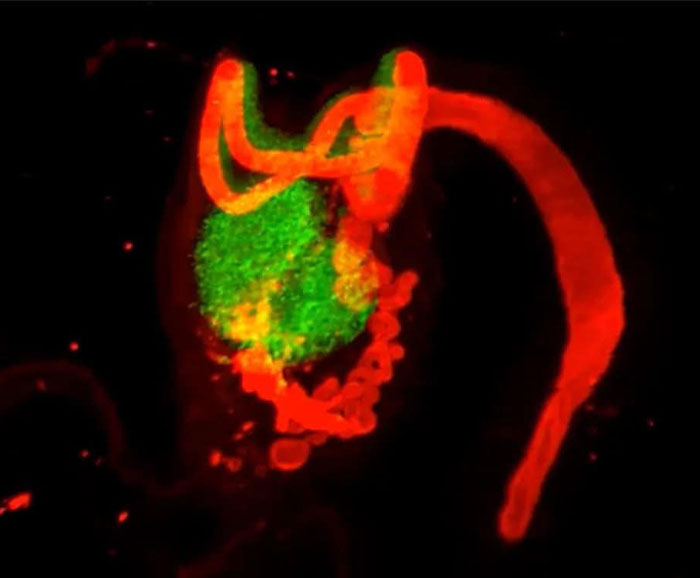
For 150 years, anatomy textbooks had a simple line on the rete ovarii: vestigial. A leftover.
First described in 1870, this small tubular network attached to the ovary, curling around it like a horseshoe, had no obvious function. So science did what it often does with female anatomy it doesn't understand, it ignored it. No mention in textbooks. No funding.
That is now changing, fast.
Two new strands of research are converging on the ovary as far more dynamic than the old idea of a ticking clock that runs out. And the rete ovarii, or RO, appears central.
In March 2025, developmental biologist Dilara Anbarci and colleagues at Duke published in 'eLife' the first high-resolution imaging of the RO in mice. They found it is not inert. It is a fluid highway directing protein-packed fluids through its long tubular structure into the ovary itself. The flow is directional, communicative, and responsive to hormonal signals, especially around estrus. It behaves less like a remnant and more like a sensory appendage.
That reframes fertility. If the RO secretes or channels signals to the ovarian follicles that house eggs, it may be actively supporting ovarian health maintenance, not memory.
A second 2026 wave of ovarian biology supports the re-evaluation. Studies from North-western and Yale on aging ovaries found that after menopause, the ovary does not simply shut down. It transforms into an immune-like organ, infiltrated by T-cells and macrophages, secreting inflammatory signals. The tissue stiffens with collagen, and softening it as a July 2026 ‘Nature Aging’ paper showed can restore pregnancy rates in aged mice from 25% to 50%.
The RO may be part of that regulatory system. Long dismissed as the female equivalent of the male rete testis which is known to transport sperm, the RO has no sperm to transport, so it was assumed useless. But the new model suggests it may transport the female equivalent: regulatory factors that keep the follicle niche healthy.
If confirmed in humans, implications are clinical. Premature ovarian insufficiency affects 3% of women. Current treatments focus on the follicles. A 2026 ‘Science’ paper showed targeting the ovarian stroma — the supportive tissue around follicles with antifibrotic drugs restored fertility. The RO is adjacent to that stroma.
We forgot an organ for a century because we couldn't see a purpose. Now we are learning the ovary has an organ we forgot to look at.