

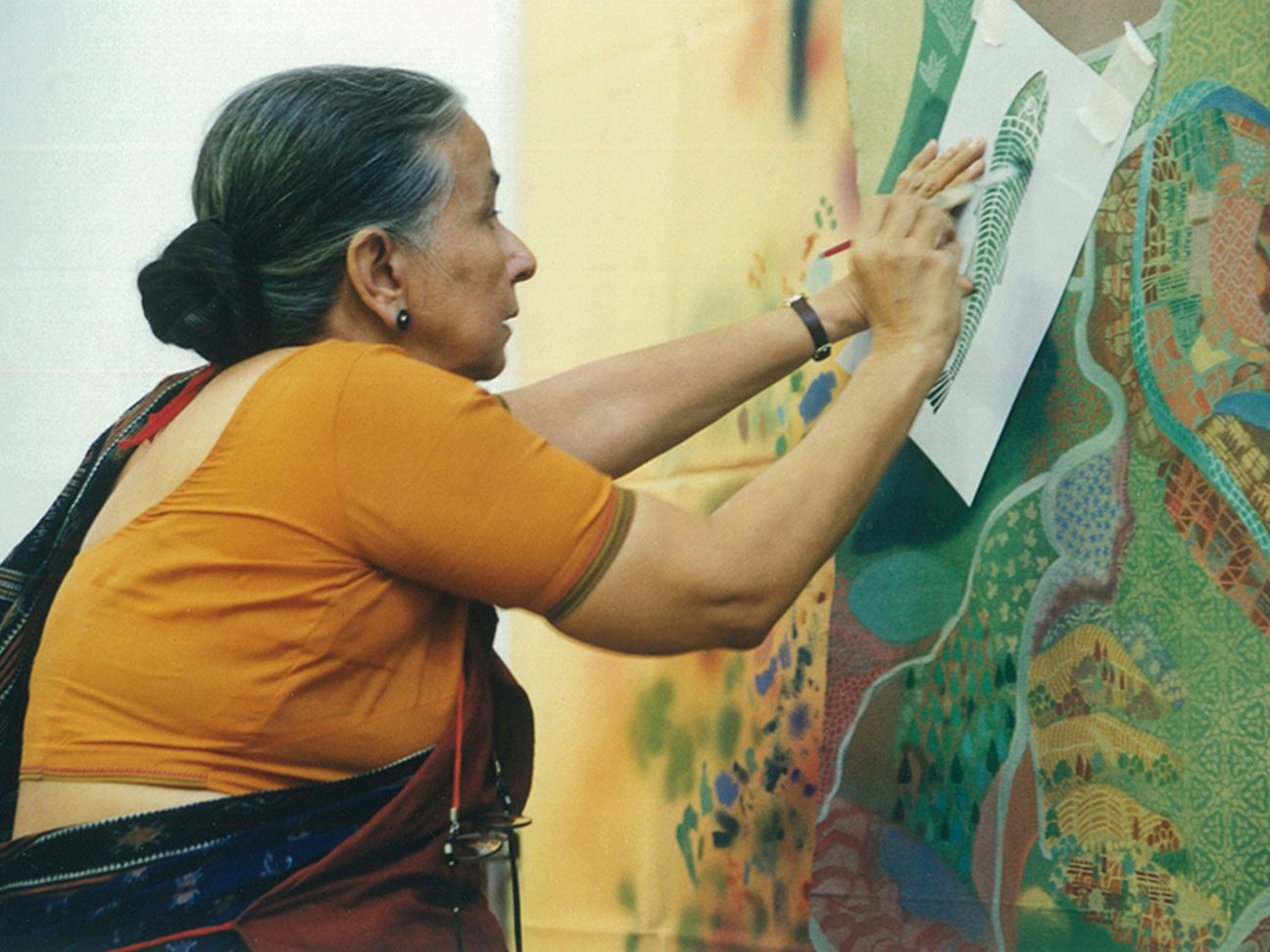
Among the most rewarding moments in Nilima Sheikh's over five-decade-long career was when the guards at her exhibition in Chicago in 2014 requested to meet her. "They had been moved by my work, comparing it with political events elsewhere," she says, sitting in her Delhi home, hours before boarding a flight to New York for opening of Fractured Stories, her survey at the Museum of Modern Art, MoMA.The exhibition, Each night put Kashmir (2003-14): "Home, Land, 4: Climate Change" and "Shamla (2025-26), in which she broadens her field to climate change, began with her first photographs of floods in Kashmir. It led to her reading Amitav Ghosh and other literature on the environmental crisis. “Glacial warming is a huge problem in the Himalayas. You see how it has been for sometimes.”, she says.
Read more - Ladakh's Slowing Glaciers
A year ago, she visited the Simurugh, Barok-based Sheikh adapts traditional folk tale from Persian manuscript, Anwar-e-Suhaili, in which the mythical bird is killed and its children rescued that has been taken by the sea, into her unique visual lexicon. Climate Change/Flood 2, is the wreath of the river, originating from a melting glacier that sweeps away the sandpipers' nest, and with it trees, boats and muddy homes. Forests burn in one image, assembly of birds flanked by Simurugh hovering over it, the destruction of human habitation looms large in another image. Sheikh paints the cycle of life, depicting both the precarity of present and hope of renewal.
"Is there any sanity remaining, perhaps it is up there," she says, adding that the idea was borrowed from her childhood. Her grandfather had founded Gulab Devi Memorial Tuberculosis Hospital for Women in Lahore in 1934 on request of Lala Lajpat Rai. Both her parents were doctors - father, a physician, mother, a pathologist. She attributes her seemingly unstoppable curiosity about natural sciences, particularly her mother, who was also a naturalist. "She was always open to the visual, she would be interested in every leaf over the place," says the 80-year-old artist.
Read more - The Archivist of Forbidden Love
The other determining factor was Delhi in the 1960s and early 70s - art room was not a space exclusively reserved for art class. "We had artists Kanwal and Devyani Krishna continuing - it was unusual for the time to have known artists as school teachers. We also had Narendra Sharma, a disciple of Uday Shankar, who introduced us to notions of modern dance. At a time when art was not seen as a viable profession, there were artists who made it the most desirable thing for me," she says.
She enrolled for bachelor's in history at the University of Delhi, which was followed by a masters in painting from MSU Baroda. Sheikh's art today is a balanced reflection of education. Dying Drawing (2007-10), for instance, carries the free-wheeling thought from her book - the juxtaposition of Kashmir's geo-political trauma with its everyday life comes from her vacation in Kashmir, watching the exquisitely detailed handwork, similar to the ones in Persian miniatures is a skill she learnt from historical paintings, not only from the viewpoint of their beauty but also from what it can say about their linguistics.
In the same vein, traditional forms have heavily informed her work as a post-modern reflection of the structure and the language of miniature painting and the technique of using casein tempera (fast-drying paint on handmade, layered wasli paper to "talk" to the Japanese painting traditions. “During my training with KG Subramanyan, he emphasised on painting Chinese poetry rather than illustrating it. With that firmly in my head, I have looked at historical paintings, not only from the viewpoint of their beauty but also from what it can say about their linguistics.”
Tags: #NilimaSheikh #MoMA #ContemporaryArt #Kashmir #ClimateArt #BarodaSchool #IndianArt #Displacement #FeministArt #FracturedStories