

Development thinkers largely view agriculture, more so peasant farming, as a sector producing too little output and incomes relative to the too many people it employs. The marginal productivity of labour in agriculture - the extra crop harvested from adding one worker on same piece of land, keeping all other inputs unchanged - is "negligible, zero, or even negative," as the 1979 Economics Nobel Prize laureate, William Arthur Lewis, put it.
The process of development, according to this world view, entails moving the "disguised unemployed" surplus workforce in farms into manufacturing and other modern "capitalist" sectors, where marginal productivity of labour and incomes or or wages are higher. Such withdrawal would actually be beneficial for agriculture; it allows for economies of scale through consolidation of existing holdings, making them amenable to use of farm machinery, equipment and capital-intensive productivity-enhancing inputs.
Read more - A Bag, A King And A Beach Full Of Aliens
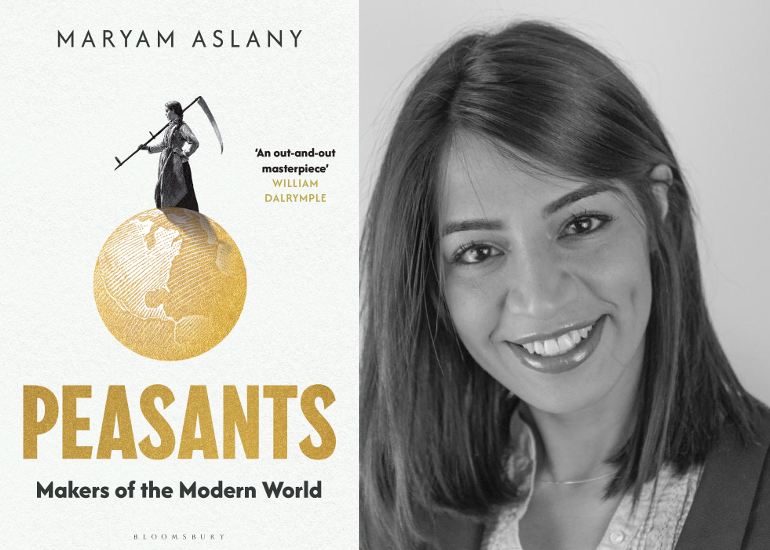
Maryam Aslany believes that the above weltanschauung - of peasants and smallholder farmers being a drag on progress and incompatible with a modern economy - has been subscribed to as much by advocates of free-market capitalism as by Marxists.
For Karl Marx, peasants were akin to individual "potatoes in a sack", lacking collective class consciousness of the industrial proletariat and incapable of revolution: "They cannot represent themselves, they must be represented". The Bolsheviks went a step further. They, like American technocrats, embraced a vision of large-scale farming. Worse, agriculture was a source of surplus that had to be forcibly extracted from the countryside to fund Soviet Union's ultra-rapid industrialisation. Under Joseph Stalin, peasants were stripped of their landholdings and brought to work on kolkhoz collectives or State-owned sovkhoz industrial farms deploying armies of tractors and combine harvesters.
Aslany is right that peasant has all but been "eradicated" in the West. The United States today has only 1.9 million farms that directly engage 1.2 per cent of its total workforce. The average farm size was 466 acres in 2024, with 50.2 per cent of aggregate value of production coming from those with $1 million or more in annual gross cash income. The European Union has more farmers (8.8 million) but agriculture's share in employment is a mere 3.9 per cent.
Read more - Headline and Footnote
But this is not so in Asia, Africa and Latin America. Aslany estimates that as many as two billion people live in peasant households worldwide. After 300 years of "modernisation", peasants still constitute a quarter of humanity, vastly outnumbering assembly-line workers, miners, taxi drivers or office drones. And more than a third of world's food comes from farms under two hectares. The Iran born-and-raised economic sociologist's contention is, perhaps, supported by evidence from India. The country has around 100 million landholding farmer families, with agriculture accounting for 43 per cent of its employed labour force in 2025. That's down from 64.6 per cent in 1993-94, which isn't significant enough from a Lewis model standpoint. The minuscule rise in manufacturing's share, from 10.4 per cent to 12.1 per cent, makes it an even less impressive structural transformation story.
Aslany's book makes two central arguments. First, peasants were key to what she calls the "biological order", when human activity was powered almost exclusively by plants and animals - and the people imbued with knowledge for collaborative relationships with their natural cycles. There could be no states or empires without peasants. They not only supplied food but generated agricultural surpluses that made it possible for cities to exist and for kings to maintain standing armies and build architectural wonders - from Egyptian pyramids and Great Wall of China to Kallanai Dam and Angkor Wat temple complex. Second, transition to an "industrial order" is not seamless. The death of peasant agriculture is a phenomenon highly specific to US and western Europe. Average farm sizes are small in Japan, South Korea and China. China has brought down share of its workforce in agriculture from 59.6 per cent to 21.7 per cent between 1991 and 2025. But as Aslany notes, "China is exceptional; it cannot become general condition". Not every country can be world's factory and today's factories, moreover, create far fewer jobs than in the past.
Tags: #Peasant #Agriculture #MaryamAslany #IndianFarming #AgrarianCrisis #SmallFarmers #LewisModel #FoodSecurity #Rurallndia #Development