

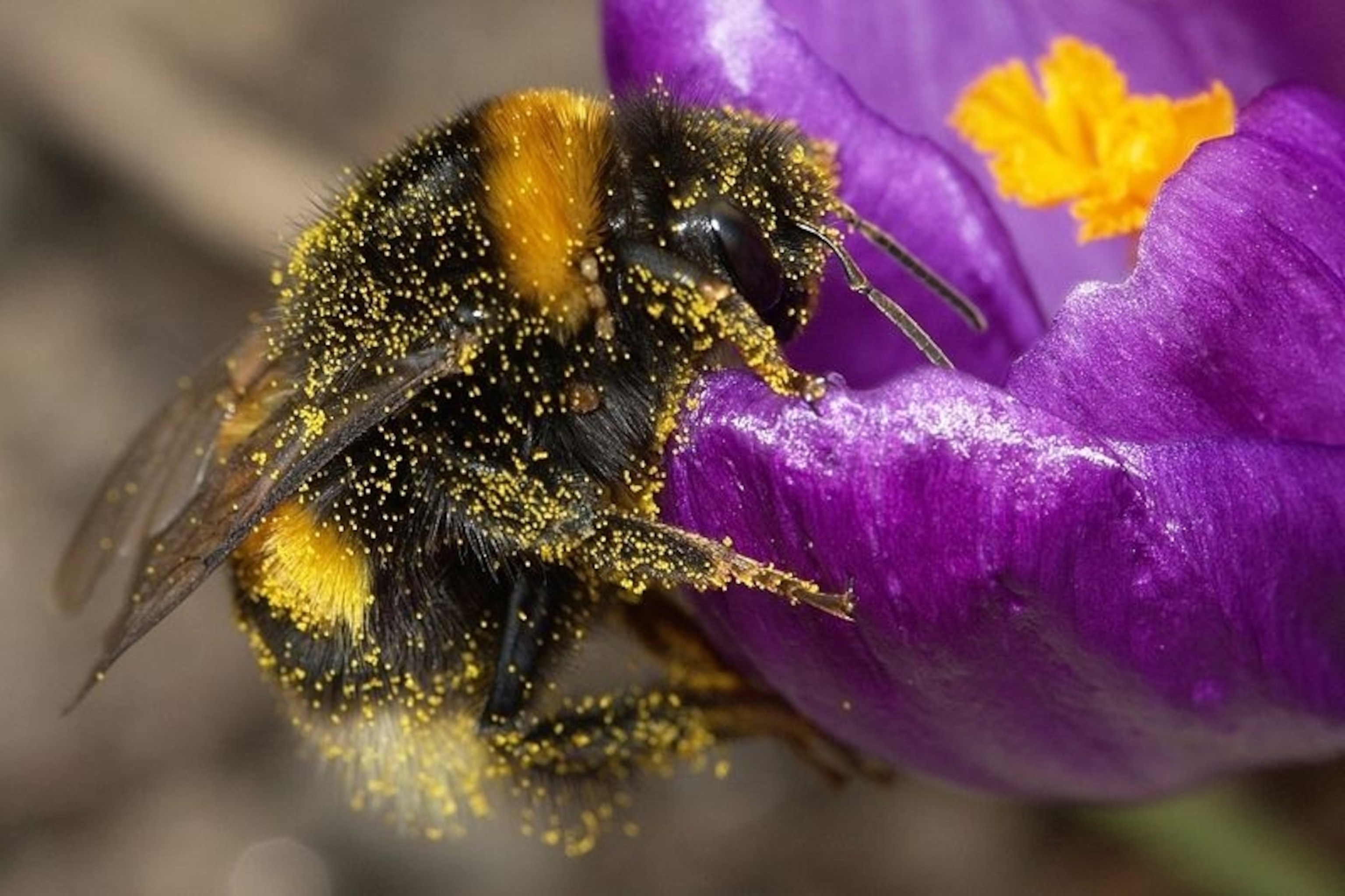
For a honeybee, the world is electric. Flowers carry negative charge, bees positive — they sense it on landing. They use Earth's magnetic field like compass, waggle dance with electric fields to tell sisters where nectar is. Now anthropogenic fields are jamming that compass.
Three peer-reviewed studies in 2023-2025 have moved this from beekeeper anecdote to measured effect.
In iScience 2025, Mallinson et al. tested weak electric fields at strengths comparable to those tens of metres from high-voltage transmission lines. Result: alternating current fields reduced honeybee landings on flowers by 71%, positive direct current by 53%. Negative DC had no effect. Near real lines, fields of similar strength span foraging heights.
Read more - When Wildlife Needs Us Less
In Science Advances 2023, Molina-Montenegro et al. studied bees near 220-kV towers in Chile. EMF exposure increased stress-related gene expression (Hsp70), cut flower visitation, impaired pollination efficiency, lowered seed production and reduced plant community richness near lines. Authors concluded: “EMF disturbs foraging capabilities by altering magnetic navigation, learning, decision-making, flight and foraging, thus impairing pollination.”
In Southampton study, Shepherd et al. 2018 exposed bees to extremely low frequency EMFs at 20 μT (ground level under lines) to 7000 μT (1 m from conductor). Learning in proboscis extension test collapsed from 73% in controls to 63% at 20 μT, 42% at 100 μT, 36% at 1000 μT. Flight — wingbeat frequency surged. Foraging flights towards food source failed more often. Memory retention dropped.
A separate 2023 homing study at 2.4 and 5.8 GHz Wi-Fi bands found significant reduction in ability of foragers to return to hive, though brood development unaffected.
Why data centers? Data centers don't emit 71% drop themselves. Their load does. IEA estimates global data center electricity demand will double by 2026 to 1000 TWh for AI — requiring massive grid expansion: new 400-kV lines, substations, each generating 5-10 μT at 1 m above ground continuously, exactly the range that Southampton showed impairs learning. Environmental Health Sciences review notes “environmental exposure to non-ionizing EMFs increasing due to explosive growth of AI and large-scale data centers.”
Analytically, risk multiplies. Bees pollinate 90% of world's crops by FAO count — 87 of 115 leading crops, most fruit, vegetables, nuts, oilseeds. Almonds 100% bee-dependent, apples 90%, blueberries 90%. Loss is not honey loss. US already lost 48% colonies in 2022-23 winter. EU pollinator decline costs €3.7 bn. EMF is not pesticide — it's sublethal, cognitive.
Read more - Sea Eating Shore
"If we lose bees, we lose far more than honey," http://earth.org quote holds, but mechanism is now precise — not dead bees, confused bees. Confused bees visit 71% fewer flowers, forget learned odour, fail to come home. Colony doesn't collapse in day; it starves slowly.
Mitigation exists — bury high-voltage lines near meadows, maintain 100-m pollinator corridors, shield substations, map data center grid with bee foraging maps. No Indian EIA currently includes EMF pollinator assessment for 500-MW AI campus.
Bee sees electric field of flower from 10 cm away. We are flooding that field with power lines feeding servers. We won't hear buzz fade — we will see fruit shelves empty.
*Tags:* #Bees #EMF #DataCenters #Pollination #iScience #ScienceAdvances #FoodSecurity #AI #Biodiversity #ElectricPollution