

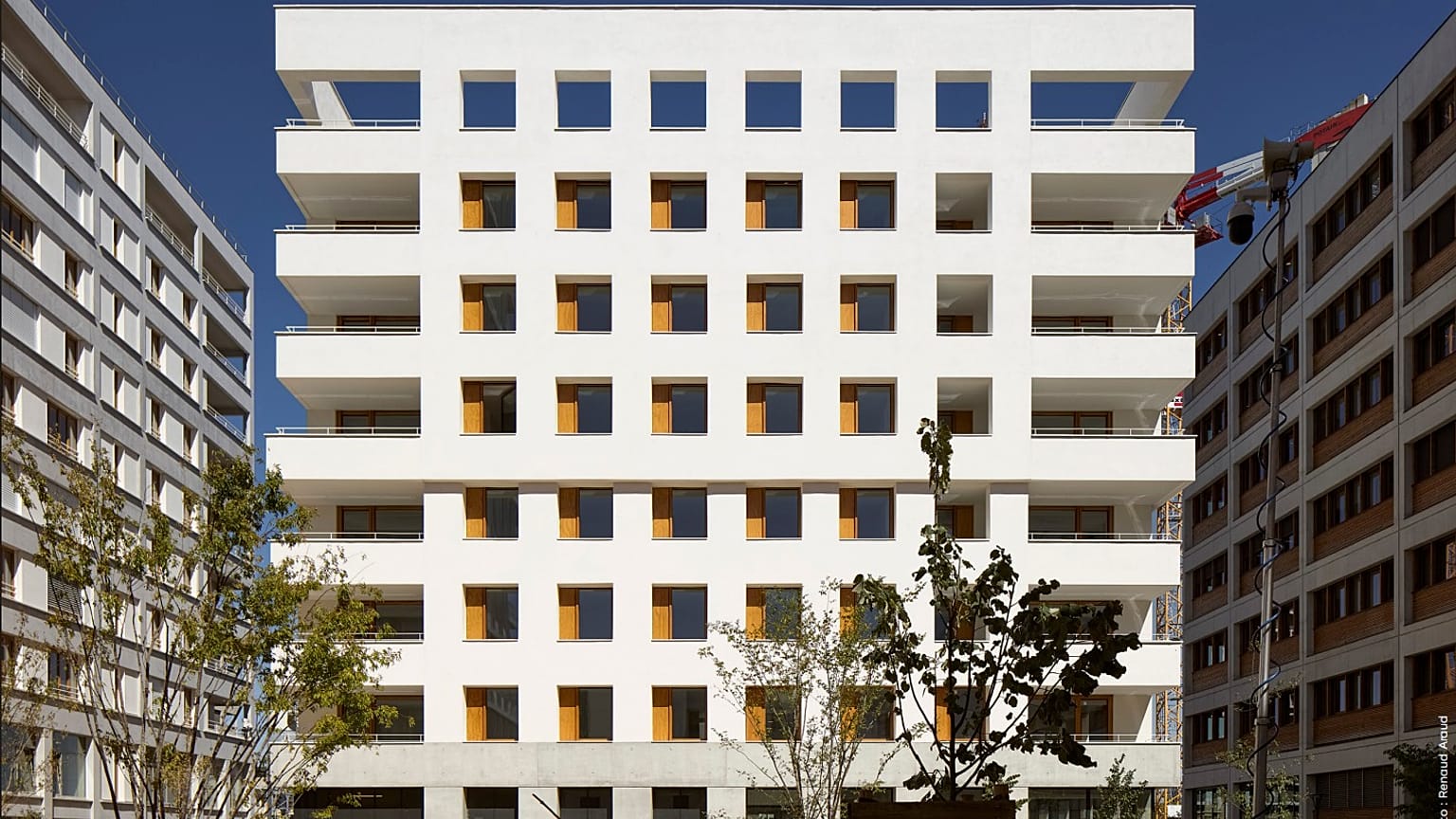
LYON: It looks like an ordinary white, cubic apartment block. It is not.
The seven-storey, 23-apartment building in Lyon's Confluence neighbourhood, inaugurated on Tuesday, is France's first residential building designed to regulate its own temperature without heating or air conditioning.
It is called 'Essentiel', and it is built on Principle 2226 — named after the comfortable indoor temperature range it aims to maintain: 22 to 26 degrees Celsius.
The concept was created by Austrian architect Professor Dietmar Eberle and his firm, Baumschlager Eberle Architects. The first 2226 building was completed in 2013 in Lustenau, Austria, as an office. Ten years later, it was still running without any heating, cooling, or ventilation technology, always at a constant feel-good temperature between 22 and 26 degrees.
Compared with standard buildings, its investment and construction costs were 25 percent lower, its energy consumption was down by 68 percent, and its life-cycle costs were reduced by 49 percent.
*It is low-tech, not high-tech:*
"It's not high-tech, we're talking about a low-tech building," says Astrid Lampl, architect and project director at Baumschlager Eberle.
“A standard building with a suspended ceiling, mechanical ventilation systems, etc. — that's high-tech; 2226 doesn't have all that.”
2226 projects are designed to minimise technical installations as much as possible. The building and its walls substitute for central heating or cooling systems, making the construction method one of the most important parts of the process.
"Since 2020, we have learnt that if we want thermal mass, we need to build heavy using materials that store heat," Lampl says.
*1. Thick walls that act like a battery:*
The secret is thermal mass — the ability of a material to absorb heat, store it, and release it slowly.
In Lyon, the walls and floors are 61 centimetres thick, roughly twice the French average of about 30 centimetres. The envelope is made from Monomur bricks — hollow-core terracotta blocks — plus concrete and a lime render.
In Lyon, the architects opted for a double brick wall because the material production plants were nearby. Two layers of hollow bricks interspersed with glass wool insulation give the building a massive appearance, while large recesses in the facade protect it from direct sunlight.
Thick walls provide protection from the heat in summer and retain the heat in winter. In summer, they keep the cool air inside. In winter, they keep the warm air inside.
Think of the building as a tree, Eberle says. It breathes independently.
*2. You are the heater:*
The second secret is that you do not need much heat.
In a super-insulated building, the heat produced by residents' bodies, cooking, showering, lighting, and electrical appliances stays inside. Sunlight coming through large, high windows does the rest.
"We are the building's heaters — ourselves and what we do," says Cedric Ata, programme manager at Nexity Auvergne Bourgogne, the developer.
"We achieve the feel-good temperature through the interaction of several temperature-regulating elements, based on an intelligent design and implemented with the right materials. People themselves and their electronic devices, plus lighting, serve as a heat source," Eberle explains. “One of the key elements is the exterior brick wall, which stores heat in winter and keeps heat out in summer.”
The apartments have higher ceilings and lintelled windows to let in the maximum amount of sunlight in winter, when the sun is low. In summer, when the sun is high, the recessed facade shades the windows.
*3. A smart operating system that breathes for you:*
The only high-tech installation in the building is the home automation system in each housing unit. Temperature, humidity, air quality, and weather are precisely monitored by several sensors inside and outside each apartment.
Wooden slats installed on every window open and close automatically to create airflow inside the rooms. These wooden vents help to regulate CO2 inside the apartments and are a great asset during heatwaves.
"We've had a lot of questions about the automatic opening. The weather station on the roof will detect cooler air at night and automatically open the vents," Lampl says.
In summer, the thick walls keep the fresh air inside, and when there are extreme temperatures outside, the vents open as little as possible, maintaining the cool. At night, when the outside air cools, the vents open wide to flush the building with cool air — night purging.
In winter, the vents open only enough to keep CO2 low, without losing heat.
Residents can also operate the slats themselves. In addition, there are ceiling fans to cool the air, making it feel up to 5 degrees cooler.
The 2226 Operating System, a smart building control system, automatically regulates temperature, CO2 levels, and humidity by means of sensors and air valves.
*What about extreme weather?*
In Lyon, the building is designed to hold 20 to 22 degrees in winter and 26 to 28 degrees during heatwaves. That is slightly wider than the original 22 to 26 ideal, because France is warmer than Austria.
In Lyon, regulations forced the developers to install a reversible dual-flow mechanical ventilation system and backup heaters. Each apartment is still equipped with heaters and is connected to the city's heating network, as French law requires.
Those heaters are designed to switch on only during extreme weather events or after the home has been vacant for a long time.
That legal requirement raised construction costs by 15 percent in Lyon. In La Garenne-Colombes, near Paris, where central heating is not mandatory, there were no additional costs. "We were able to install cheaper electric radiators, which will be used very little," Lampl says.
*Does it save money?*
Nexity says the technology should reduce energy consumption for thermal comfort by 73 percent and cut carbon emissions by 65 percent over 50 years.
According to Nexity CEO Veronique Bedague, this will cut energy bills by 80 percent — about 380 euros a year for a three-room apartment.
The building is fully recyclable, Eberle says, because it uses no composite insulation, no plastic membranes, and no complex mechanical systems that become waste.
*Will it work everywhere?*
The concept was born in the cold climate of Austria. It has since been built in Switzerland and Germany, and now in France.
Its scalability is in doubt. Renaud Peyre, eco-adviser to the Lyon metropolitan authority, told _Vert_ that this project cannot be replicated on a large scale, calling the smart-home system too complex and expensive for a standard construction model. In his view, the best way to improve housing energy efficiency remains renovation.
Researchers are now adapting the idea for other climates — 22/26 Midwest in the United States, and passive cooling in hot, arid climates like Burkina Faso, using hempcrete to absorb humidity naturally and a solar chimney to dry it.
For India, where the previous story in this series showed glass towers turning into ovens, the lesson is opposite but related: build heavy, not light; build with mass, not glass; let the building store heat and release it slowly, rather than fighting heat with air conditioning.
The 2226 building does not fight the climate. It uses it.
#2226 #Architecture #PassiveHouse #Sustainability #Lyon #BaumschlagerEberle #Energy #Heating #Cooling #Buildings