
CHENNAI: Tamil Nadu's public libraries have been filled with books that do not exist in the way they claim to.
The books carry fictitious author names, invented histories, plagiarised and AI-generated content, bogus ISBNs, and inflated prices. They were bought with public money, approved by committees that never recommended them, and placed on the shelves of libraries meant for students preparing for competitive examinations.
The scam came to light on November 6, 2026, when the well-known Tamil writer Perumal Murugan published an article in the online magazine ‘Sindhai’ titled ‘(Periyar) Arivulagathil Periya Oozhal’ — A Major Scam at Periyar Arivulagam.
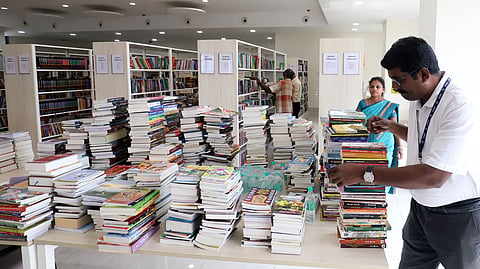
Murugan had visited the Tamil section on the fourth floor of the newly opened Periyar Arivulagam library in Coimbatore, a huge complex inaugurated on October 16 by Chief Minister C. Joseph Vijay. He found around 1,800 books published by Agal Vilakku Pathippagam. The list, he wrote, was dreadful — full of factual errors, made-up author names, and completely bogus ISBNs.
*What Murugan found:*
In one book, ‘Naladiyar’, a collection of classical Tamil verses, had become a poet and a philosopher.
Another book, ‘Madurai Kanchi Oru Ilakkiya Payanam’, attributed to Dev Nilan and priced at Rs. 1,395, claimed that ‘Madurai Kanchi’ was written by a king called Madurai Koozhathip Peruvazhuthi. The accepted author of the Sangam-era work is the poet Mangudi Maruthanar.
A book titled ‘Bharathiyar Kathaigal’ , attributed to Manisha Saravanan, credited Bharathiyar with a story, ‘Sadhanaiyin Mugam’ , whose style Murugan questioned.
‘Keeladi Seppum Varalaru’ by Jothi Hariharan carried a photograph of a large Nandi sculpture as an artefact supposedly discovered at the archaeological site.
A book on Tamil Nadu by Dhanalakshmi Arjun identified Muthuvelu Subbaiya Iyer as the state's first Chief Minister in 1947 and referred to former Chief Minister M. Karunanidhi as M. K. Ramasamy.
Murugan wrote, "Some of these books appear to have been produced using AI." Attempts to verify their ISBN numbers returned no results.
"The publisher called Agal Vilakku has a fake address, and so does Phoenix Publications. These appear to have been created just to supply these books," Murugan told NDTV.
*The arrest:*
The Directorate of Vigilance and Anti-Corruption (DVAC) arrested publisher R. Mohan on Monday, November 16, over allegations that he supplied government libraries with books carrying fictitious authors' names and material drawn from websites and ChatGPT, in collusion with unidentified officials.
Mohan owns Agal Vilakku Publishers and Phoenix Publications, which, according to the FIR, operate from the same address in Chennai's Madipakkam. The two firms received Rs. 1.74 crore for supplying books to public libraries across Tamil Nadu.
The case, registered on November 15, names Mohan, unidentified public servants at the Directorate of Public Libraries, the Anna Centenary Library in Chennai, and Periyar Arivulagam in Coimbatore, and other unidentified persons.
The School Education Department had sought a DVAC enquiry on November 6. The Madurai Bench of the Madras High Court directed the registration of an FIR on November 10. Five library officials were suspended on November 15.
The DVAC also conducted searches at the newly established libraries in Kancheepuram, Ranipet, Tirupattur, and Tenkasi, besides Mohan's residence in Chennai and a publishing facility at Kudavasal in Tiruvarur. Three bank accounts containing approximately Rs. 22 lakh were reportedly frozen.
*How the books got in:*
The alleged operation depended on more than invented authorship. According to the FIR, a coordination committee added books that an expert recommendation committee had not recommended, and then submitted them for selection without recording the additions in the relevant file.
"The lists of the two publishers were accepted without scrutiny," the FIR states.
Agal Vilakku submitted 2,339 titles and Phoenix submitted 99. Purchase orders covering 1,857 books were issued in February 2026, when the DMK was ruling the state.
Investigators described the disputed contents as vague, misleading, and lacking educational or informational value.
The procurement formed part of a Rs. 50-crore allocation for Periyar Arivulagam's books and e-books, with a Rs. 30-crore advance authorised.
The ISBN portal revealed that 2,393 books were registered under Agal Vilakku Pathippagam between December 3, 2024, and February 6, 2026. Forty-six titles were registered on February 4, and another 48 on February 5 — the day the list was placed before the High-Level Committee.
*A rush before the elections:*
A rush to procure one lakh books within three months, before the model code of conduct came into force for the 2026 Assembly elections, may have enabled the scam.
Book procurement for five new libraries — Periyar Arivulagam in Coimbatore, Kamarajar Library in Trichy, Bharathidasan Arivulagam in Salem, Anjalai Ammal Library in Cuddalore, and Quaid-e-Millath Library in Tirunelveli — was meant to follow a four-stage process. Subject experts from 53 domains would recommend titles, 15 scholars would shortlist them, a procurement committee would negotiate prices, and a high-level committee would grant final approval.
The previous government constituted the committees on November 5, 2025, setting a three-month deadline to procure one lakh books for the Periyar library's inauguration in February 2026.
Initially, experts submitted around 20,000 recommendations. With insufficient time to identify the remaining 80,000 titles, officials collected lists directly from publishers and sent them to the selection committee. A government source said it would have been impossible for 15 scholars to scrutinise so many titles, potentially allowing fake books into the procurement list.
*It is not just one publisher:*
Researchers have raised concerns about English-language books as well. S. Satheesh Kumar, who verified the library's English collection, found more than 200 titles from 3GE Learning Publications with allegedly fake ISBNs. Priced between Rs. 6,000 and Rs. 9,900, some books carried dubious publisher website details and fictitious author credentials.
In one instance, a book on electronics and instrumentation named a Pakistani woman as its editor. When contacted, she said she was an environmental scientist. Kumar also found books containing over 60 percent plagiarised content, with apparently fabricated authors.
A book wrongly credited to the eminent economist Jean Drèze has been found in a public library in Madurai. The book, 'Democracy and People's Rights in the Contemporary World', published by Phoenix Publishing House, was among the dubious publications at the centre of the scam. Drèze has denied writing it.
School Education Minister A. Rajmohan said investigators had begun inquiries at the Anna Centenary Library and that steps were being taken to question the owner of Agal Vilakku. He alleged a network operating for years, using artificial intelligence, shifting author identities, and multiple publishing names to get books into collections across Tamil Nadu. Information received by the government indicated that 20 publishing-house names had been used as proxies.
Around 3,000 suspected books in Coimbatore had been boxed and sealed, he said, while 523 had been identified at Chennai's Connemara Library.
*The politics:*
The controversy has snowballed into a political slugfest between Chief Minister Vijay's Tamilaga Vettri Kazhagam (TVK) and the main opposition party, the DMK, with both sides accusing each other of responsibility for the questionable purchases.
Minister Rajmohan said the purchase of these dubious books started in December 2025 and went on until March 2026, when the DMK was in power. The DMK has dismissed the allegations as politically motivated and has called for an inquiry.
Congress MP and Tamil Nadu Congress Committee president Manickam Tagore, now an ally of the TVK after the party's break with the DMK, has demanded a wider investigation.
The Madurai Bench of the Madras High Court has ordered a full inquiry into the procurement process.
*What next:*
The procurement of books for public libraries across the state has come to a standstill, while authorities frantically pull out fake books generated with AI tools.
The DVAC said its investigation would be extended to examine whether other publishers had supplied similarly questionable books. The case has been registered under the Bharatiya Nyaya Sanhita, the Prevention of Corruption Act, and the Copyright Act, invoking charges including criminal conspiracy, cheating, criminal breach of trust, fabrication of documents, criminal misconduct by public servants, and copyright violations.
For a state whose library movement was meant to help rural students prepare for competitive examinations and meet new technology challenges — such as, ironically, AI — the blow is profound. A library built to honour Periyar's love of reason has become a symbol of how easily reason can be faked.
#TamilNadu #LibraryScam #PerumalMurugan #Periyar #DVAC #FakeBooks #AI #DMK #TVK #Chennai