
SRINAGAR: A group of prominent Muslim clerics who attended the Waqf Day function in Srinagar on Monday (November 23, 2026) apologised on Wednesday and "offered repentance prayers" over standing during the ‘Vande Mataram’ song, as the incident triggered a wave of protests from religious groups in J&K.
"It was a mistake. We regret it and seek forgiveness from Allah," the clerics said in a video message circulated on social media.
"Some things unacceptable from the Sharia point of view took place on the occasion. We repent for the same. We went outside the venue, immediately recited ‘kalma’ in a congregation and offered our repentance. Ulemas from other sects also attended it. We did not recite anything from our hearts. Allah will accept our repentance," said Maulana Farooq, accompanied by other clerics.
As an act of repentance, the clerics recited the 'Kalma' — the core Islamic declaration of faith — and offered prayers seeking forgiveness.
What happened on November 23?
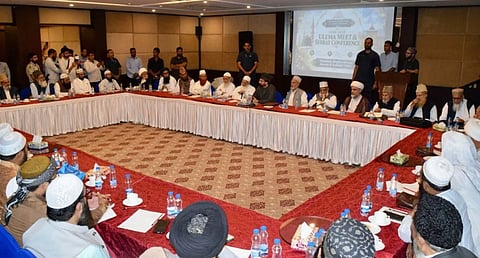
The controversy was sparked by the first-ever Waqf Day function organised by BJP leader and J&K Waqf Board chairperson Darakhshan Andrabi at the Sher-e-Kashmir University of Agricultural Sciences and Technology (SKUAST), Srinagar.
Union Minority Affairs Minister Kiren Rijiju was chief guest. National Conference MP Mian Altaf Larvi and Shia cleric and J&K Peoples Conference leader Imran Reza Ansari also attended.
At the event, the full ‘Vande Mataram’ song — all six stanzas — was played with several top Muslim clerics on the dais as well as in the audience. Videos of imams standing for the rendition were widely shared on social media, and they came under strong criticism.
Those who attended included Mufti Syed Basharat, Mufti Farooq, Mufti Inayatullah Qasmi, Maulana Farooq, Maulana Basharat Sakafi, Pir Syed Ejaz, Maulana Zakir, Abdul Rashid Dawoodi and imams of the Dastigeer Sahib shrine and the Hazratbal shrine.
Why some scholars object?
Sections of Muslim scholars consider ‘Vande Mataram’ un-Islamic because some of its stanzas invoke the motherland in divine form and refer to Hindu goddesses.
Many Muslims draw a distinction between loving one's country and worshipping it. They say 'Vande Mataram' ('I bow to thee, Mother'), which treats the homeland as a deity, is incompatible with Tawheed — the Islamic tenet of monotheism, the oneness of Allah — which forbids worship or bowing before anything else.
"Any expression or practice that attributes divinity to the motherland is contrary to the fundamental Islamic belief of Tawheed and is, therefore, un-Islamic and impermissible for Muslims," the Muttahida Majlis-e-Ulama (MMU) said.
The MMU, an amalgam of religious organisations headed by Mirwaiz Umar Farooq, said it was highly "regrettable and unacceptable" that ‘Vande Mataram’ was played at the function of the Waqf Board, an institution entrusted with safeguarding Muslim religious endowments.
"There was no legal obligation to play ‘Vande Mataram’ simply because it was an official function, and playing it was optional," said the MMU.
Why the full version was played?
All six stanzas were played in accordance with a Union Home Ministry protocol directive issued earlier this year, mandating the full version at state functions, official events and legislative sessions.
In August, the President gave assent to the Prevention of Insults to National Honour (Amendment) Act, placing 'Vande Mataram' on a par with the national anthem. While it did not change the stanzas, it made disrespect towards or disruption of the national song punishable.
Reaction-
Maulana Rahmatullah, who heads Kashmir's biggest seminary, Darul Uloom Raheemiyyah, welcomed the “act of repentance by the Muslim priests for their mistake.”
The clerics, in a press conference in Srinagar, said: “We won't go into the details, but during the event, there was something which was against the Shariah, and we are repenting for the mistake. This should not be given a sectarian colour because scholars of every sect were present there.”
The Waqf Board and the Minister have not yet issued a formal statement on the apology.
The episode has now added a new layer to the controversy — raising questions about religious freedom, political pressure, and the space for individual choice in public events.
*Tags:*
#VandeMataram #JammuKashmir #WaqfBoard #Clerics #Srinagar #Mirwaiz #KirenRijiju #DarakhshanAndrabi #Tawheed #ReligiousFreedom