
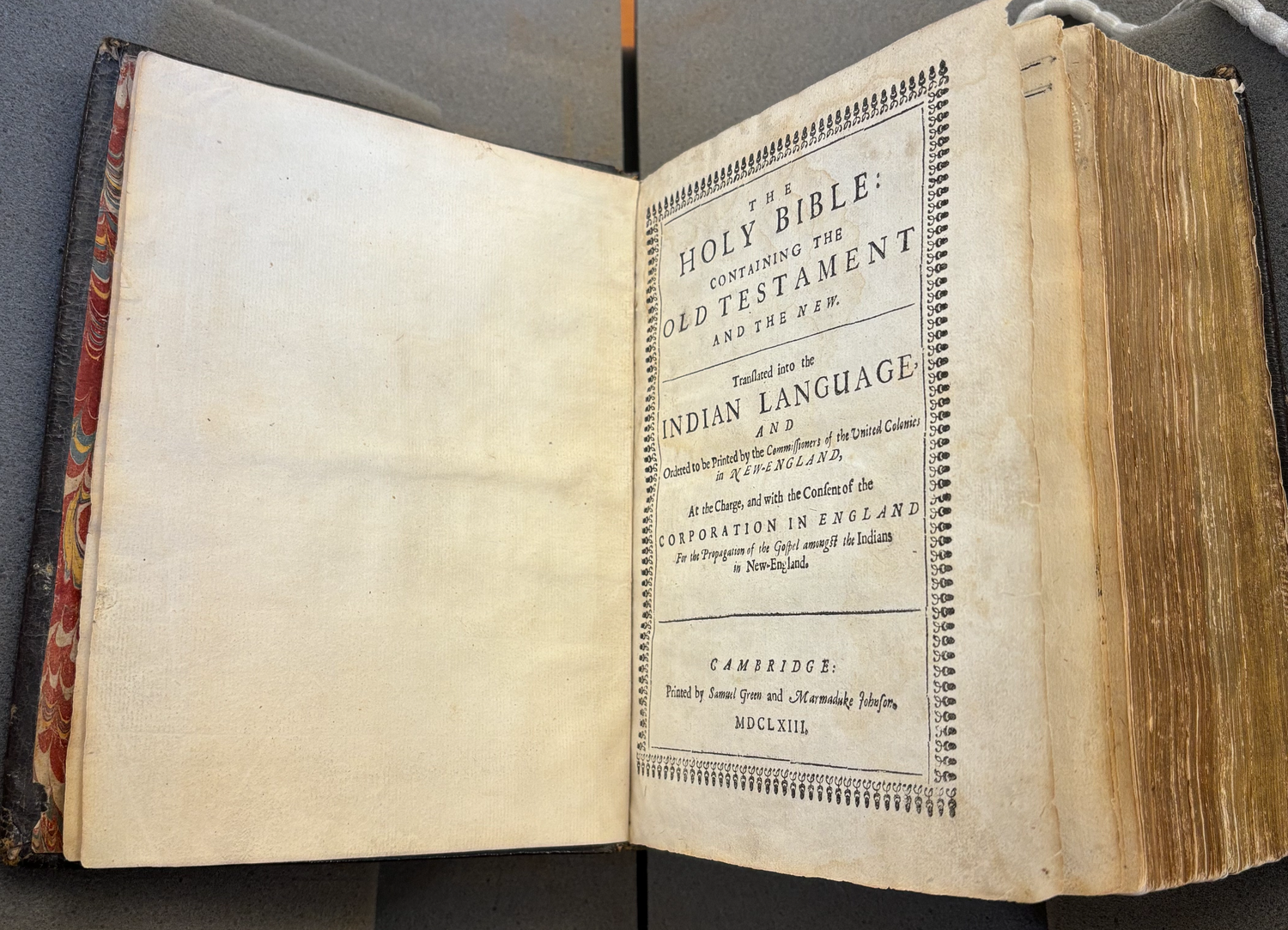
CAMBRIDGE: In 1663, colonial printers in New England produced a translation of the Bible into Wampanoag, an Algonquian language spoken in southern New England. Also known as Wôpanâak or Massachusett, it was one of several Native American languages in the region.
Printing the book would be an important story on its own. But it is even more remarkable because it was the first Bible that English colonists published in North America.
It is also the first Bible printed anywhere in the Western Hemisphere. And the first complete Bible translated into a non-Western language for missionary purposes.
The man who gets the credit, and the men who did the work—
Puritan minister John Eliot (1604-1690), called the "Apostle to the Indians," translated the Bible into Wampanoag with the aim of converting Native Americans.
Eliot did not know Wampanoag.
He met an interpreter who impressed him: 'Cockenoe', a Montauk man from Long Island who had been taken captive during the Anglo-Pequot War in 1637. He became crucial to Eliot's cause.
Eliot called Cockenoe a "pregnant witted young man." He pronounced words clearly, which was crucial: like almost all Native languages in North America at the time, Wôpanâak did not have a writing system, so Eliot needed to transcribe what he heard.
Cockenoe's instruction enabled Eliot to produce religious works in Wampanoag, including the Ten Commandments and the Lord's Prayer.
Other Native assistants were essential too:
- *Wawaus*, a Nipmuc man from what is now central Massachusetts, also known as *James Printer*, helped set type for the book.
- *John Sassamon*, a Massachusett man educated at Harvard, helped with translation and teaching.
- *Job Nesutan*, a Massachusett man, also worked on translation before his death in 1675.
Eliot created an orthography — a writing system — which he taught to the Wampanoag. Many became literate, using Wampanoag for letters, deeds, and historic documents.
The book—
‘Mamusse Wunneetupanatamwe Up-Biblum God. Naneeswe Nukkone Testament kah wonk Wusku Testament.’
[The Holy Bible: Containing The Old Testament and The New. Translated into the Indian Language, And Ordered to be Printed by the Commissioners of the United Colonies in New-England, At the Charge, and with the Consent of the Corporation in England For the Propagation of the Gospel amongst the Indians in New-England.]
Printed in Cambridge by Samuel Green and Marmaduke Johnson — New Testament 1661, Old Testament 1663, bound together 1663.
Eliot had also been involved in the translation and printing of the first book printed in the American colonies, the "Bay Psalm Book" of 1640.
About 1,000 copies of "Eliot's Bible" were printed, but only 42 copies are still extant today.
Why it was made?
Eliot was intent on translating the Bible. His goal was conversion.
The Massachusetts Bay Colony had established "Praying Towns" — Natick, founded 1651, was the first — where Native people who converted to Christianity lived under English law, farmed in English style, and worshipped in English style.
The Bible in Wampanoag was a tool of that project. It was also, unintentionally, something else: a preservation.
It is one of the few documents we have in the Natick / Wampanoag language. For linguists, it is a treasure.
At least one word of the Natick language was taken over into English thanks to Eliot's Bible. For the concept of an officer, captain, or duke, the Natick Bible uses the word 'mugquomp'— a word alive and well in English as 'Mugwump'.
The other side of the story—
The same people who taught the Pilgrims to grow corn, squash and beans — the Three Sisters — in 1620-21, who taught them to fish and collect seafood, who saved Plymouth from starvation, were within a generation being pressured to give up their language, their religion, their land.
King Philip's War (1675-76), led by Metacom, son of Massasoit, devastated the Wampanoag. James Printer fought on both sides. John Sassamon's murder was a trigger for the war. Job Nesutan died in it.
The language declined. By the 19th century, Wôpanâak was considered extinct — no fluent native speakers remained.
Revival—
But the Eliot Bible did not die.
In the 1990s, Wampanoag linguist *Jessie Little Doe Baird* began the Wôpanâak Language Reclamation Project, using the Eliot Bible, Eliot's grammar, and other colonial documents as the foundation to reconstruct the language.
In 2010, she won a MacArthur "genius" grant for that work. Today, Wampanoag children are learning Wôpanâak again in school in Mashpee. The first Bible in America is now a textbook for bringing a language back to life.
That is the irony: a book made to convert a people became the book that helped save their language.
*Tags:*
#Wampanoag #EliotBible #FirstBible #NativeAmerican #Wôpanâak #JohnEliot #Cockenoe #JamesPrinter #LanguageRevival #Massachusetts