

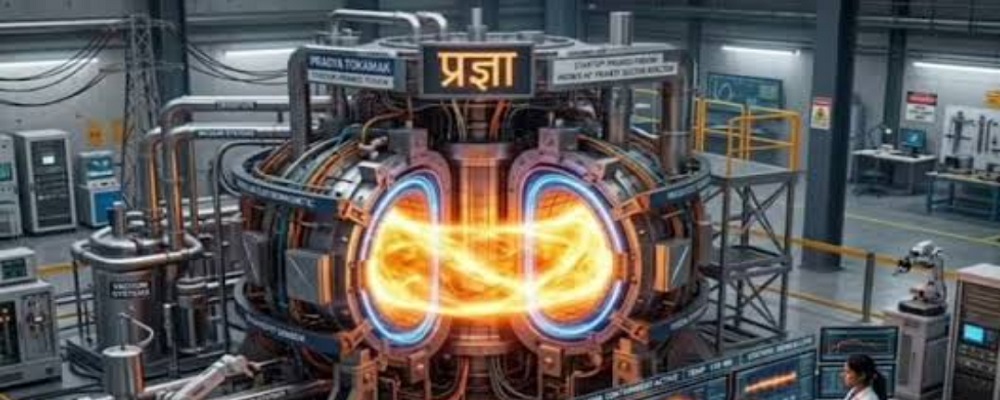
India has achieved a ground-breaking milestone in the field of fusion energy. A leading Indian tech start-up has made history by successfully generating its first plasma within its indigenous tokamak, 'PRAGYA'. This success places India among the select group of nations rapidly working towards developing an 'artificial sun' to harness clean and limitless energy for the future.
A tokamak is a device that uses powerful magnetic fields to confine and control extremely hot plasma. The process of nuclear fusion generates energy by fusing atoms together at immense temperatures, mimicking the mechanism found in stars and the sun. The successful generation of plasma in 'PRAGYA' demonstrates that Indian scientists and engineers are fully capable of executing complex physics and advanced engineering.
A key highlight of this project is its reliance on entirely indigenous technology. Indian researchers designed and manufactured the tokamak's superconducting magnets, vacuum vessel, and plasma control system domestically. This has not only eliminated dependence on foreign technology but also significantly reduced project costs, setting a new global benchmark.
According to scientists, nuclear fusion energy represents the safest and most carbon-free energy source for the future. Unlike nuclear fission, it produces no long-term hazardous radioactive waste and carries no risk of catastrophic accidents. If this technology becomes fully viable and commercially successful, it could offer a permanent solution to both the global energy crisis and climate change.
This historic achievement has sparked immense enthusiasm within India's energy sector and scientific community. Both the government and private investors have pledged to increase collaboration in fusion energy research. With this success of 'PRAGYA', India is now preparing for the next phase of trials, which aims to raise the plasma temperature to levels exceeding that of the Sun's core and sustain it for an extended period.