

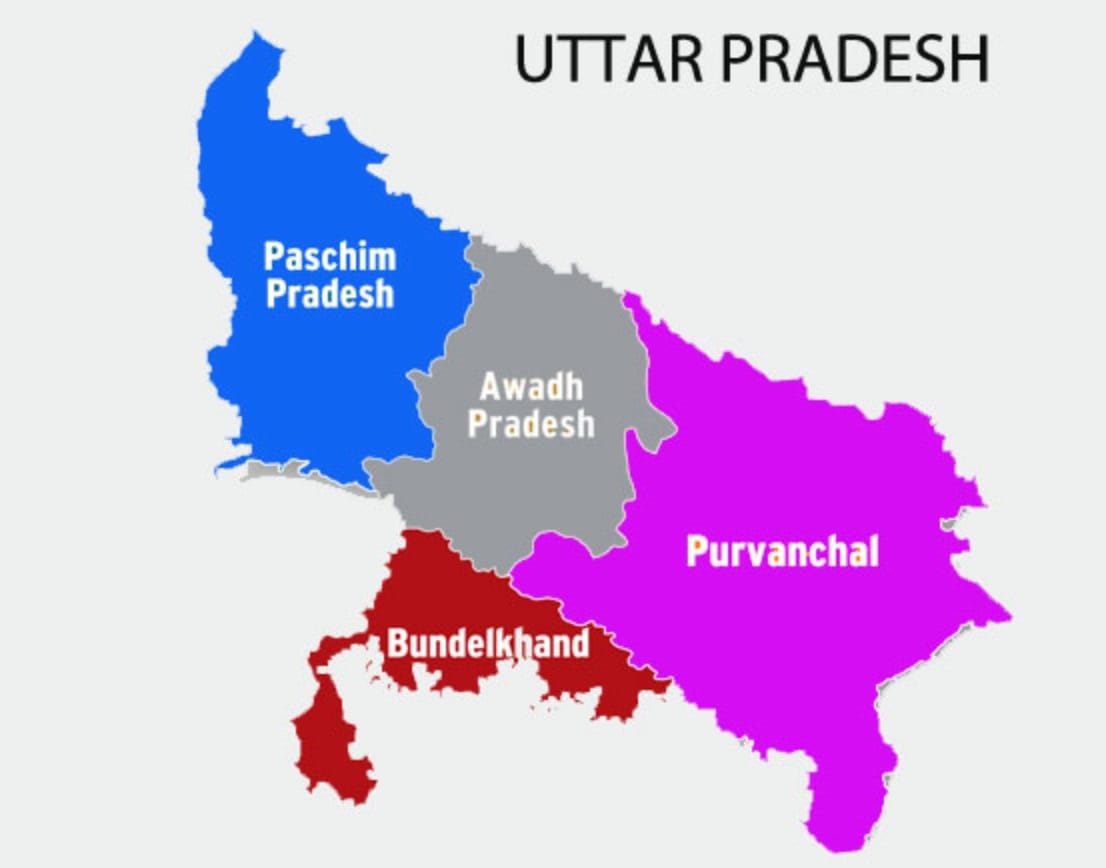
Uttar Pradesh is too big to govern, and too big to ignore. Now, Bahujan Samaj Party chief Mayawati has revived the demand to split it into four — Purvanchal, Bundelkhand, Avasadh and Paschim Pradesh. She claims PM Modi will do it after BJP loses.
The demand is not new. In November 2011, Mayawati's government passed a resolution in the Assembly to divide UP into four. The logic: smaller states mean better governance. The 2011 map carved 28 districts into Purvanchal, 7 into Bundelkhand, 23 into Paschim Pradesh, 17 into Avasadh.
Why does the demand persist? UP's 243 million people make it larger than most countries. Bundelkhand, in particular, feels underdeveloped and drought-prone.
But politics explains the timing. For BJP, smaller states could be strategic. In 2017, it won big in western UP, where the Jat base dominates — a separate Paschim Pradesh could consolidate that. For BSP, with its Jatav-Dalit core, a separate Purvanchal with high Dalit population is attractive. For Mayawati, now electorally weakened, the demand is a way to re-energise cadres.
Constitutionally, Article 3 allows Parliament to form a new state by law. The President must recommend the bill, and the state Assembly must be consulted — but its views are not binding. It is ultimately a simple majority in both Houses.
In reality, no party wants to be the one to actually split India's most politically valuable state — home to 80 Lok Sabha seats. As one BJP leader said, "That some posts" can also bring back some votes. The demand is pre-poll posturing, but it taps into a real governance deficit.