

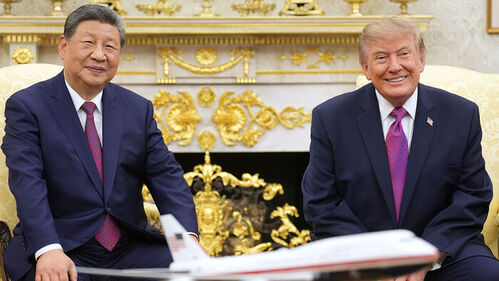
On September 22, Japanese PM Sanae Takaichi rushed to New York to seek Trump's security reassurance. On September 23-24, Trump rolled out the red carpet at Andrews and the White House for Xi Jinping. Protocol told the story: supplicant versus state guest.
But substance told more. The White House fact sheet of eight outcomes says: "The two leaders recalled that United States and China were allies in World War II and fought side by side to win the war." Trump, in the welcome, praised the Flying Tigers volunteer pilots who fought Japan over China. "Look at the greatness that we had together fighting in World War II," he said at the state dinner.
Xi answered: "During World War II, China and the United States stood shoulder to shoulder to fight against fascist aggression... friendship, forged in blood and fire." He recalled Chinese civilians rescuing hundreds of US pilots downed over the Hump route, at cost of hundreds of thousands of Chinese lives.
Read more - The Yuan Turning Point
For Tokyo, it was a cold shower. Nikkei and Yomiuri called it "unusual" and worrying. Takaichi, who days earlier at UNGA demanded deletion of UN Charter's "enemy state" clause, a relic allowing action against WWII aggressors — had warned of a "new form of militarism" narrative from Beijing. Now Washington echoed Beijing's narrative.
From an Indian perspective, this is classic great-power management at middle-power expense. India knows the feeling: 1971 US-China rapprochement was also over our region. The blow to Japan's right wing is twofold. First, historical: Japan's revisionist lobby, which for decades has tried to whitewash Nanjing and justify Unit 731, shielded after WWII by US deal for biological warfare data loses its US cover when US itself cites joint war against Japanese militarism. Chinese FM spokesman Guo Jiakun on September 26: Japan must “fully remove pernicious influence of militarism.”
Read more- The China Loophole
Second, strategic: If US-China build "constructive strategic stability" as first consensus point says, with cooperation on AI and restraint on Taiwan, Japan fears abandonment. Takaichi's 20-minute call with Trump post-summit was spun as coordination, but Tokyo is scrambling. Record defense budget 8.89 trillion yen for FY27 shows hedging.
Overreaction exposes unease: Japan wants to be normal power, but its past still needs US amnesia.
#China #US #Japan #WWIIHistory #Takaichi #XiJinping #Trump #RightWing #IndianPerspective #IndoPacific