

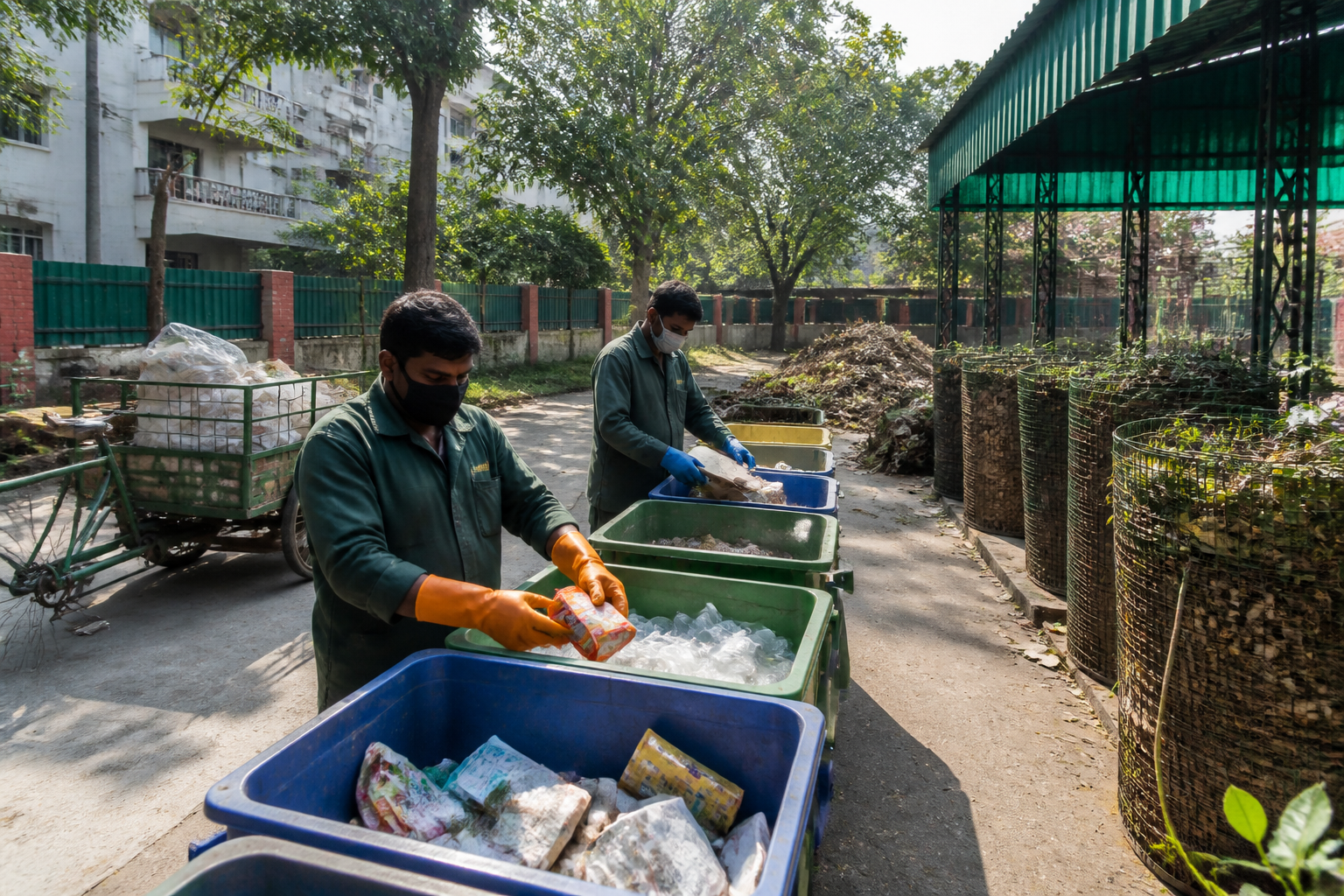
Every morning at 6.30 am, while most of Delhi's garbage begins its journey to overflowing landfills, waste from over 300 homes in Chanakyapuri's D1 and D2 blocks and Satya Sadan flats takes a different route - to a Material Recovery Facility at Madhu Limaye Marg, just 1.5 km away.
The model is disarmingly simple. Resident Welfare Association hired Arjun, a 30-year-old collector, who picks segregated wet and dry waste on a bicycle cart. At the MRF, Amit Kumar, Sanitary Inspector, processes 800 kg to 1,200 kg wet waste and 250 kg dry waste daily. Wet waste is crushed, put in 10 aerobic rounders - cylindrical permeable containers - reduced to half its volume in two to four months. Jaggery water or curd acts as enzyme accelerator. Final compost goes back to residents for gardens. Dry waste - PET bottles, cardboard, aluminium - goes to authorised recyclers.
Read more - Maritime Surge: A Navy Drive
In June 2025, these three blocks became first to be declared 'Anupam Colony', a zero-waste certification by NDMC as part of its decentralised initiative. Nine blocks have received it.
Why this matters for India: Urban India generates 62 million tonnes of waste annually, with Delhi's three dumpsites already over capacity. Centralised processing has failed - high transport costs, high operational costs, chemical use. NDMC advisor Rajiv Jain admits scaling is a challenge due to space crunch, but Chanakyapuri proves decentralisation costs less - Rs 3.5 lakh setup with simple steel rounders, no chemicals, low operational cost.
The roadblock is behaviour. Getting residents to segregate at source remains a challenge across NDMC, despite repeated sensitisation. Cost is not an obstacle, mindset is. The RWA now wants bins outside each house and a third category for hazardous waste - sanitary waste, batteries - which NDMC has introduced but not fully implemented.
If Lutyens can do it with low-tech, why can't Dwarka or East Delhi? Zero waste is not a technology problem; it is a colony problem.
Tags: #ZeroWaste #SwachhBharat #NDMC #Chanakyapuri #WasteManagement #CircularEconomy #Delhi #Composting #RWA #Sustainability