

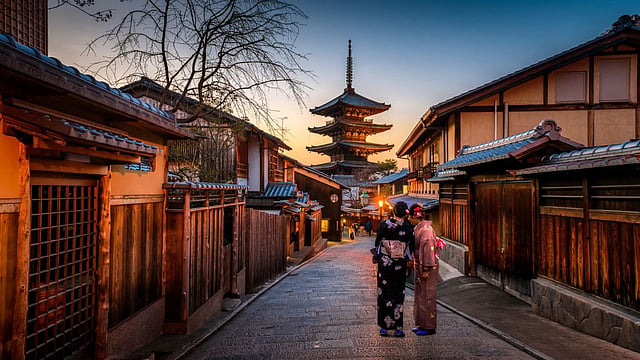
There is a version of Japan that most Indians have already done - the first trip. Tokyo, Kyoto, Osaka. The essential tourist trove gets you in the country, everything in this piece urges you to go beyond. Japan is deep enough that a first trip will leave you already planning for the next, and Veena World's Neil Patil lays out why.
What actually stays with you when you have walked Shibuya, seen the Golden Pavilion of Kyoto or the neon shrine of Osaka, there is a second Japan waiting, quieter and denser, built for people who notice.
For Indian travellers, Japan is disorienting in the best way. “I want to walk through three ways the one week itinerary collapses if you let it”, Patil writes. “Where you actually go. Where you actually sleep. Where you actually eat”.
The first difference: You do not need to wait for someone. There is a word in Japanese for what happens when you sit alone at a narrow counter in Tokyo, order a bowl of ramen, and simply eat, at Ichiran. Ohitorisama - the honourable person of one. Nobody at that counter is looking at you with pity. Japan has perfected solo existence. It is a recognized, designed-for reality. If you have spent the last decade or more in India, where eating alone is still explained away, this is liberating. A friend with an appetite for long days and unfamiliar places, planning for once the first trip beyond the obvious, Japan finally tells you how that waiting alone is not stalled time, but permission to stop waiting.
Otorisama is masterclass enough to have spawned an entire service economy around solo dining - solo karaoke, solo packages. Walk into almost any canteen bar or sushi restaurant in Tokyo and you will find a screen or partition that shields you with deliberate attention. The two may even keep a rhythm that helps you focus on your food without interruption. You are not eating alone in spite of Japan. You are eating alone because of it.
Also a fear worth naming, honestly, the fear that travelling alone as a woman might not be safe, or that the eyes of people back home. That fear is real in India. In Japan, it carries little weight. That Japan consistently ranks among the safest countries in the world for solo and especially female travellers in particular describes why - They rarely worry about wandering alone at midnight in a city of strangers, eating alone, sleeping alone, being alone wherever, being alone in public here is to be almost invisible. And invisibility in Japan also makes the practical side easy.
Read more - We Take Your Souls': A New Rhetoric of Modern War
The Shinkansen and urban rail network is a marvel of efficiency, safety and punctuality. You can get off at any airport kiosk and tapped at every turnstile. The biggest English language barrier from transit almost vanishes. Japanese transit with a provision that will surprise you, down to the exact platform and carriage: 7-Elevens, FamilyMarts, and Lawsons, are everywhere, with hot food, foreign-card ATMs, and printing.
Sleep Somewhere That Is Not A Hotel: The food is genuinely the main event, and lodging too. Most of Japan most of those visitors never get past that mid-range hotel room. It is called a minshuku, and if you have spent time in ryokans, you are missing something significant. Think of a minshuku as a family-run guesthouse, a Japanese equivalent of a bed and breakfast, except the family actually lives in the house. The room is simply someone's house. The room is tatami, futon, a small desk and low table, elaborate kaiseki dinners, to be mistaken for a traditional ryokan, the hall bath with communal washing before. Atashinabe is everyday kaiseki dinners, sometimes cooked by mother. It comes out of a closet each evening, and in early about the pre-industrial family-style ofuro, a traditional Japanese soaking bath.
And then there is the Japan that resists. Patil recounts Kanazawa on the Sea of Japan coast - Japan's most underrated city, more than a photographer's backdrop. Kanazawa, the former samurai quarter, is a city that has almost entirely to yourself on a cold Tuesday morning in January. Around 98 per cent of Japan's gold, leaf, come from here. Or Manjimido in Nagano Prefecture. It is also the best for the tourists. It is also the best for the Alpi, with Karuizawa, a protected alpine valley closed to private cars, less than an hour away.
Read more - Gukesh The New Emperor of Chess
Most telling is the story of Takao Shito, who still farms a small plot of land inside Narita Airport's boundary today. His fields reachable through underground tunnels, his refusal to be bought forced Narita to permanently alter its second runway, and the taxiway to be shortened. The small patch of carrots and peanuts land from a working vegetable farm that international flights taxi past on their way to Asia. It is, as far as knows, the only major international airport in the world with an active farm inside its own perimeter, a farmer who refused to give up their land.
That is the different Japan Indians should seek - not just punctual trains, but a country that accommodates a single farmer against a state.
*Tags:* #JapanTravel #Ohitorisama #SoloTravel #IndianTraveller #NaritaFarm #RajabaiToShinkansen #CulturalTravel #VeenaWorld #SlowTravel #JapanOffbeat