

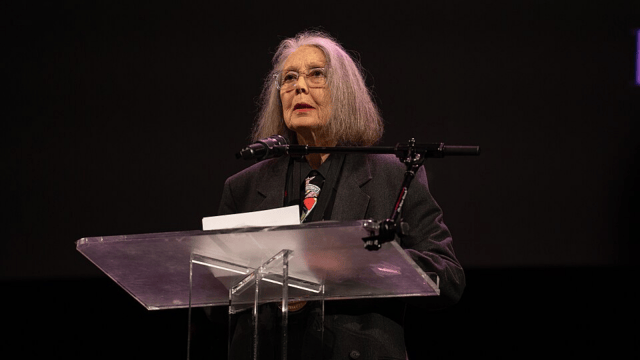
"I want to be unbearable," Anne Carson declares. “There's a sotto voce rage against the agents and engines of genre, representation and interpretation. She will not be reduced.”
For Sumana Roy, who teaches a course called 'The Disobedient Women of the Essay' at Ashoka University, Carson's Nobel was personal vindication. From Joan Didion to Virginia Woolf, Susan Sontag to Anahid Nersessian, Roy's syllabus is about women who refuse a genre's uniform. Carson is their patron saint.
Read more - 460 Minutes of Inequality
Her disobedience began early - with a PhD titled Odi et Amo Ergo Sum, "I Hate and I Love, Therefore I Am," rejection of Descartes. Her first book was not a novel but a work of literary and philosophical criticism derived from her doctoral dissertation, Eros the Bittersweet, with subtitle "An Essay." It's a word - a category - she would return to repeatedly, to excavate, to inflate, to argue with, to demolish, to build antechambers, to rescue, to renovate, to rehabilitate.
In The Beauty of the Husband, an essay that includes narrative verse, the sections are named not by chapter but by tango dance form, because its subject is a failed marriage. Her first book of poems combined art history and optical theory while questioning post-Renaissance ideas of perspective. Then there's The Glass Essay, a poem she called a lyric essay. Autobiography of Red, a novel-in-verse that, like much of her writing, reimagines ancient Greek myths; Nox, an experimental accordion-fold art book for her estranged brother; Decreation, the title itself holds the spirit of her creative practice.
Why does this matter for India? Because our literary criticism still lives in borrowed uniforms - poetry must be poetry, essay must be academic, memoir must confess. The Indian essay, especially in English, is often corporate hand-me-down, income and increments in media and academia. Carson offers another lineage: Dubravka Ugrešić and Ann Patchett, Annie Dillard and Elizabeth Tova Bailey, Chimamanda Ngozi Adichie - and now an Indian classroom reading them.
Read more - She Is The Farmer
Roy's students - "most of them women" - annotate deviations, digressions and disruptions that sexists force on corporatised essay. Carson tells them you can write about your mother as much as Emily Brontë, about Sappho as much as dinner. That small, short, the stanza, the section - their forms of attention, disruption, distraction and interruption - can be subject of a lifelong exploration.
#AnneCarson #Nobel PrizeLiterature #SumanaRoy #DisobedientEssay #AshokaUniversity #TheGlassEssay #AutobiographyOfRed #EssayWriting #WomenWriters #LiteraryCriticism