

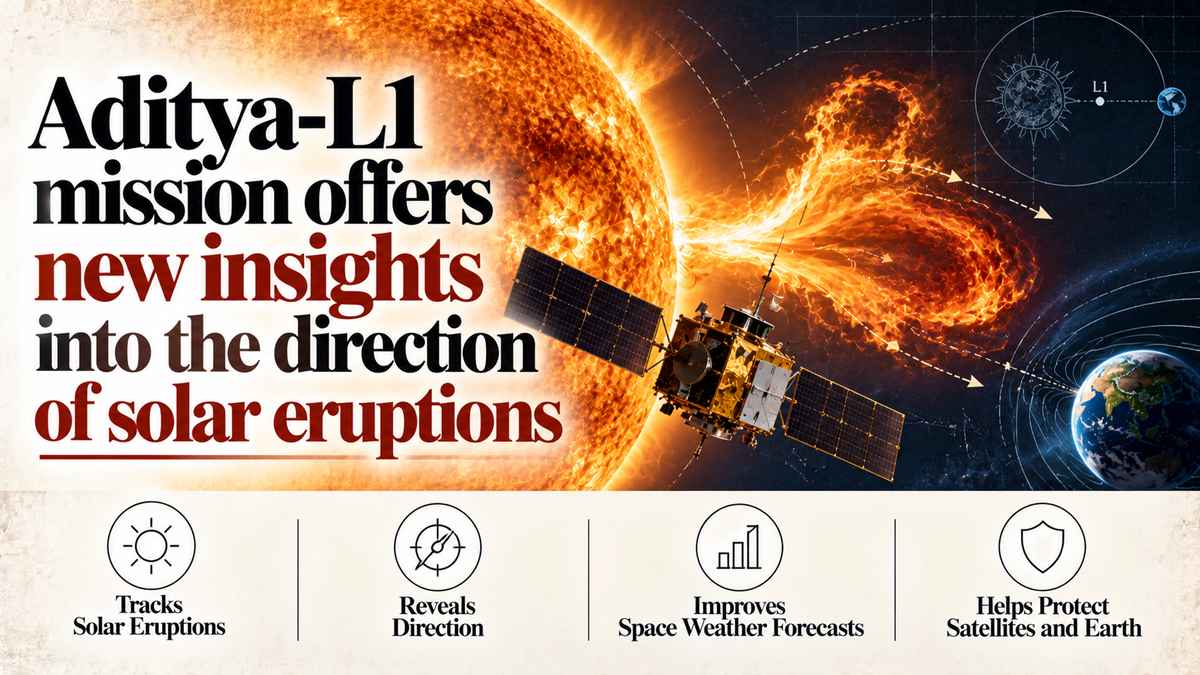
Aditya-L1 mission offers new insights into direction of solar eruptions - Scientists have generated Doppler velocity images of activities taking place in solar corona using data obtained with Visible Emission Line Coronagraph payload on board India's maiden solar mission Aditya-L1.
Aditya-L1 satellite generates Doppler velocity images of solar corona, and these images expected to provide information on propagation of coronal mass ejections along Sun-Earth direction, which has been unavailable to date.
Read more - Gaganyaan & Beyond: ISRO's Next Big Milestones
Scientists at Indian Institute of Astrophysics who generated Doppler velocity images said it is well known that solar activity leads to ejection of hot plasma. They said massive and energetic plasma cloud ejected during powerful eruptions like CMEs can travel either in direction of Earth or in any other direction from Sun. Scientists said that because CMEs can disrupt near-Earth space, it is important to infer their direction of propagation from Sun as they erupt. "Universally, it is taught in high schools that Doppler effect in sound helps to understand whether train is approaching railway station platform or moving away from it. A person standing on platform would hear steady increase in pitch of sound waves due to train's whistle or horn when train is coming into station. Pitch would steadily decrease when train is moving away from station," scientists said.
Doppler velocity - Using similar Doppler effect concept in light waves, scientists have now generated Doppler velocity images. "Positive and negative Doppler velocities indicate solar plasma moving away from and towards direction of observer, respectively," they said. Detailed software for processing VELC data developed by Dr V. Muthupriyal, Senior Project Scientist with VELC payload operations team in IIA, and her team. Technical details related to data processing have been published recently in Astrophysical Journal after international peer review.
According to R. Ramesh, Senior Professor in IIA and Principal Investigator, VELC project, Doppler velocity images of solar corona are unique. Only VELC has capability to generate such images at present due to its one-of-a-kind spectroscopic observing capability in visible wavelength range, he said. He added that related processed images will be disseminated to scientific community.
Read more - New Space Agreement Between ISRO and ESA Extending to 2032
Analytically, Aditya-L1 at Lagrange Point 1, 1.5 million km from Earth, is India's first space weather observatory. Doppler imaging helps predict whether CME will hit Earth, causing satellite disruption, GPS failure, power grid issues - critical for India with 500+ satellites and growing aviation. While NASA's Parker Solar Probe touches Sun, VELC gives unique visible-light view. For ISRO, success builds case for L2 mission.
Tags: #AdityaL1 #ISRO #VELC #SolarEruption #CME #IIA #DopplerVelocity #SpaceWeather #SunMission #Astrophysics