

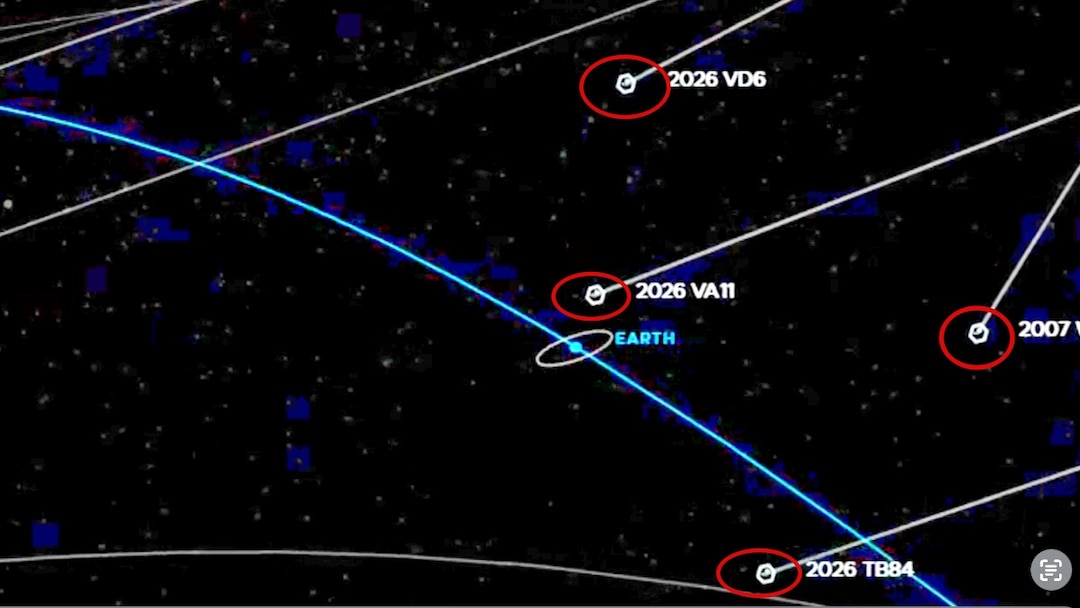
NEW DELHI: NASA monitoring five asteroids scheduled approach Earth within next 48 hours. These space rocks pass varying distances between Nov 19-20 no threat impact.
Asteroids include 2026 VA11, 2026 TB84, 2026 VD6, 2018 NE1, 2007 WK3. Asteroid 2026 VA11 closest encounter Nov 19 coming within approximately 3.35 million km Earth.
NASA tracking efforts focus understanding orbits physical characteristics near-Earth objects. Although asteroids do not pose imminent threat monitoring aids refining orbital calculations. Larger asteroids over 140 metres heightened interest due potential significant regional damage if collide Earth.
The five:
1. 2018 NE1 — Nov 19, 02:15 UTC
First pass. Distance 6.38 mn km 16.61 lunar distances. Speed 13.28 km/s 47,800 km/h. Size H 23.4 — approx 70-150m? Actually ~ 85m estimate. Largest of five, but farthest.
2. 2007 WK3 — Nov 19, 07:18 UTC
Distance 5.47 mn km 14.23 lunar distances. Speed 7.76 km/s 27,936 km/h. H 26.2 — small ~ 20-30m bus-sized. Time uncertainty under 1 minute — orbit well known since 2007.
3. 2026 VA11 — Nov 19, 11:25 UTC — CLOSEST
Distance 3.35 mn km 8.72 lunar distances. Speed 8.87 km/s 31,932 km/h. Estimated 10-22 metres house-sized. Discovered this month, yet timing uncertainty under 1 minute.
4. 2026 TB84 — Nov 19, 22:18 UTC
Distance 4.64 mn km 12.08 lunar distances. Speed 9.87 km/s 35,532 km/h. Estimated 50-110 metres plane-sized. Largest new discovery. H 23.6.
5. 2026 VD6 — Nov 20, 10:35 UTC
Distance 4.01 mn km 10.45 lunar distances. Speed 9.45 km/s 34,020 km/h. H 26.8 — ~ 15-25m.
All inside NASA Asteroid Watch dashboard cutoff 4.6 mn miles 7.4 mn km 19.5x Moon distance, but still 8-16 times Moon away. Moon 384,400 km.
Why not hazardous?
NASA CNEOS classes asteroid potentially hazardous only if minimum orbit intersection distance ≤0.05 AU about 4.65 mn miles and absolute magnitude ≤22.0 corresponds roughly 140m across. None five meet both. TB84 close size but MOID larger, others too small.
Even 50-110m TB84 if hit — Chelyabinsk 2013 was 20m injured 1,500, Tunguska 1908 ∼50-60m flattened 2,150 sq km forest — would be regional, not global. But it misses by 4.6 mn km.
What NASA does:
JPL Center Near-Earth Object Studies CNEOS, Asteroid Watch dashboard, Pan-STARRS Hawaii, Catalina Sky Survey Arizona, NEOWISE space telescope track. ESA July newsletter counted 41,958 known near-Earth asteroids 1,429 discovered since Jan. NASA planetary defence lists 11,343 NEAs larger 140m found estimated 14,000 still undiscovered as Dec 3 2025.
One tracking site counted 118 asteroids passed within one lunar distance Earth 2026 as Sept 21 — normal.
If real impact threat identified agencies issue formal warnings UN Office Outer Space Affairs International Asteroid Warning Network. As today no warning active anywhere world. No tracked asteroid collision course next 100 years.
Next:
Nov 21 2026 VN11 passes 1.98 mn km 5.15 lunar distances. Nov 22 2026 WJ passes just 645,270 km 1.68 lunar distances — much closer, small ∼20m.
DART mission 2022 proved deflection works — crashed spacecraft Dimorphos changed orbit 32 minutes. NEO Surveyor telescope launch no earlier June 2028 aims discover 90% asteroids comets larger 460 feet within 30 mn miles Earth orbit.
Headline "headed towards Earth" scary. Reality: headed past Earth, like cars on highway next lane.
Watch sky, don't panic.
#Asteroid #NASA #Space #NEO #CNEOS #JPL #Earth #2026VA11 #PlanetaryDefence #Science