

ALCHI: As one walks down the narrow lanes towards the monastery, past fluttering prayer flags and the rhythmic hum of prayer wheels, time slows down. Elderly residents, dressed in traditional sulmas and kantop caps, move unhurriedly through the village, chanting.
Unlike most Ladakhi monasteries, which are built on hilltops like fortresses, Alchi is built on flat ground, on the south bank of the Indus, about 70 km from Leh. It is not a gompa in the conventional sense, but a choskhor— a sacred enclave and a centre of learning. No monks reside here. It is looked after by monks from nearby Likir monastery.
The Dukhang and the Sumtsek are the repositories of some of the rarest and finest Buddhist wall murals dating back a thousand years.
A monastery born of translation:
Alchi's existence is attributed to the translator and royal chaplain Lotsawa Rinchen Zangpo, who played a pivotal role in the Second Diffusion of Buddhism in the trans-Himalayas.
Tradition holds that Rinchen Zangpo thrust his walking stick along this very path, and it miraculously grew into a tree. Today, it is regarded as a sacred landmark by visitors making their way towards the monastery.
Inscriptions, however, name Kalden Sherab and Tshulthim O of the powerful Dro clan as founders of the Dukhang and the Sumtsek, complicating the older legend. Most scholars therefore credit the Dro-clan patrons while acknowledging the Rinchen Zangpo and Kashmiri-artisan tradition.
Alchi is one of 108 monasteries said to have been constructed around the 11th century across the trans-Himalayan region, including Ladakh, Lahaul, Spiti, Kinnaur, and Western Tibet.
Walls as canvas:
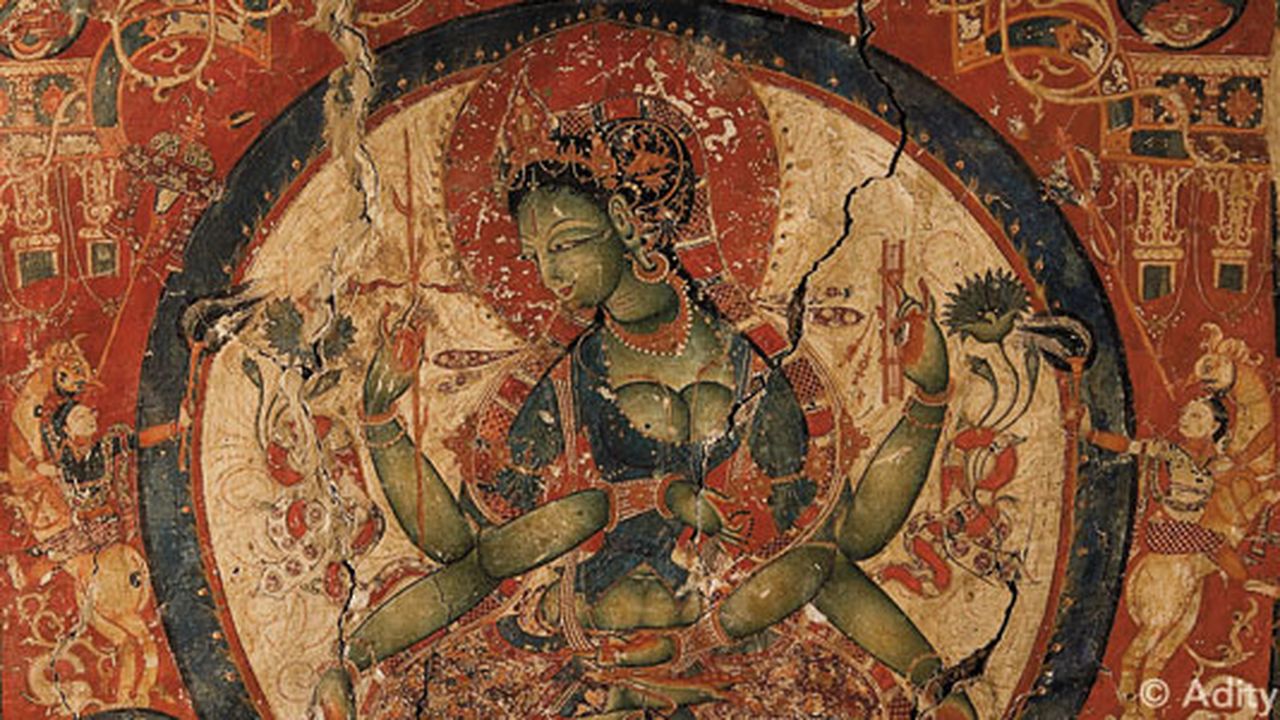
Rich in detail, Alchi's murals are among the finest examples of the surviving Kashmiri-influenced Buddhist painting tradition. They offer an insight into the epochs, religious practices, and courtly culture of 11th-century Kashmir. Covering the walls and ceilings of the temples, these intricate paintings transform the interiors into immersive visual narratives.
Reflecting on the exquisite murals, eminent filmmaker, photographer, and art historian Benoy K. Behl, who has visited the complex 12 times as part of his extensive documentation of Buddhist art and culture in Ladakh, says: “After the glorious paintings of Ajanta, the paintings of the early temples of the trans-Himalayas are regarded as the next most important body of Buddhist paintings in India.”
"Alchi is one of the 108 monasteries constructed around the 11th century across the trans-Himalayan region, including Ladakh, Lahaul, Spiti, Kinnaur and Western Tibet. I have had the privilege of documenting each one of these," he recalls.
The temple walls feature some of the most spectacular mandalas in vibrant hues, alongside hundreds of medallions depicting small seated Buddhas, rendered in ochre, black, green, azurite, and gold, alongside rare depictions of flying Buddhas.
Where cultures converge:
What makes Alchi extraordinary is not just age, but fusion.
The painters, who came from Kashmir or worked in its manner, used a refined line, rich colour, and elaborate ornament. Their work blends Kashmiri artistic techniques with Tibetan religious themes, Indian iconography, and Central Asian dress and textiles.
Beyond the resplendent rows of Bodhisattvas, the monastery also has depictions of Hindu deities, including Vishnu, Brahma, Shiva, Parvati, Ganesha, Skanda, and Yama. There are scenes of a royal drinking party, with figures in Central Asian dress, and depictions of the goddess Prajnaparamita and Green Tara. The textile patterns in the paintings show links with the Islamic world of Iran and Central Asia.
It is a record of a world connected by trade, pilgrimage, and ideas along the Silk Route. Kashmir and Ladakh have been deeply interconnected through trade, pilgrimage, and intellectual exchange. Positioned along the fabled Silk Route, Ladakh functioned as a vital conduit linking Kashmir to Tibet, Central Asia, and beyond.
The Sumtsek — a three-storeyed wonder:
The Sumtsek, or three-storeyed temple, was one of the principal Kashmiri architectural forms followed in the monasteries of the Second Diffusion.
Its carved wooden facade has trefoil arches in the Kashmiri style. Inside, three giant clay figures of bodhisattvas — Avalokiteshvara, Maitreya, and Manjushri — rise through the storeys. Their lower garments are painted with tiny scenes: palaces, pilgrimage places, and court life, which serve as a record of the textiles and buildings of the period. The Maitreya is more than four metres tall.
The upper walls carry mandalas and figures of the deities of the yoga tantras.
The Dukhang, the assembly hall, has walls covered with mandalas, and over its entrance a painting of the Wheel of Life. It holds a large Sakyamuni Buddha statue surrounded by intricately painted murals of scenes from the life of the Buddha.
The Manjushri Lha-khang and the Lotsabha Lha-khang complete the complex, each with its own carved wooden doorways, floral patterns, and religious symbols.
Why it survived:
Alchi's paintings are prized because the Buddhist art of Kashmir itself was almost entirely destroyed. Alchi is the best-preserved of a small group of Ladakhi temples painted in the same tradition. Mangyu, in a side valley a few kilometres away, and Sumda Chun, further south, have related paintings and clay sculpture and are thought to belong to the same period and workshops.
The paintings survived because the buildings fell out of active use and were little altered. Worship is said to have lapsed in the 15th century. The monastery, discarded as a religious order, escaped the 17th-century invasion of Ladakh by Ali Mir, a ruler from Baltistan.
They have suffered from water and smoke, and from growing numbers of visitors. Since the late 20th century, conservation teams from India and abroad have worked on the temples. Photography is not allowed inside, to protect the vulnerable murals. Visitors leave cameras in lockers, remove shoes in shrine rooms, and keep silence.
The site has been proposed for inscription as a UNESCO World Heritage Site.
A living village:
Alchi is not just a museum. It is a village. Apricot trees, willow trees, a prayer wheel turning in the courtyard, a lone lama sitting guard — the monastery is woven into daily life.
As visitors approach, the distant chime of temple bells grows distinct, their rhythmic resonance merging with the crisp mountain air. Vehicles must be left a few hundred metres away, compelling visitors to walk through a narrow alley bustling with life. Lined with market stalls, the pathway showcases jewellery, Buddhist relics, and souvenirs.
In the dim, incense-scented halls, many visitors describe a contemplative stillness and a meditation on impermanence — the very thing the fading pigments quietly enact.
The art was never decoration. The murals are read as Vajrayana meditation supports, visual mandalas mapping the path to awakening, and the colossal bodhisattvas bring that pantheon into bodily scale.
A thousand years ago, Kashmiri hands painted a world where India, Tibet, Central Asia, and Persia met. At Alchi, that world is still standing.
#Alchi #Ladakh #Buddhism #Monastery #Murals #Kashmir #RinchenZangpo #Indus #Art #Heritage