

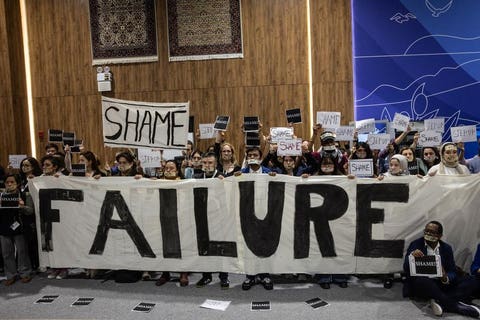
ANTALYA: The 31st Conference of the Parties (COP31) to the UN Framework Convention on Climate Change closed two days behind schedule and without a cover decision after a deadlock over whether the final agreement should even name 'fossil fuels'.
But the greater failure was its inability to turn the commitments made at Baku and Belém into working machinery.
Time is running out-
At current emission levels, the world will exhaust its carbon budget for 1.5°C of warming in about four years, according to the Global Carbon Budget 2025.
Even if countries deliver on their current Nationally Determined Contributions, the Emissions Gap Report 2026 projected 2.6°C of warming this century.
"Fossil fuels must go the way of the dinosaurs," UN Secretary-General Antonio Guterres said at the onset of COP31, urging governments to tax windfall profits of oil companies.
COP31 ended with no mention of fossil fuels at all.
What collapsed?
The draft *Antalya Pact*, proposed by the co-presidencies Türkiye and Australia, failed to secure agreement after two weeks.
Nearly 40 countries — including the EU, UK, Panama, Vanuatu, Marshall Islands, Belize — formally objected to the final text.
"We will not endorse a cover decision... that does not even mention fossil fuels, which is the key driver of climate change," said Ireland's climate minister Darragh O'Brien, whose country holds the rotating EU presidency.
“And we will not accept a COP that greenwashes fossil fuel.”
EU representatives called a deal that ignored phasing out fossil fuels “unconscionable.”
On the other side, Saudi Arabia and Russia objected to any mention of fossil fuels. Saudi Arabia, OPEC members and other petrostates have long opposed language targeting fossil fuels, saying they need to be part of the global energy mix.
The result: the draft removed coal, oil, gas and "transition away from fossil fuels" language agreed at COP28 in Dubai, replacing it with an "irreversible global transition" to low-emission development — and promoting carbon capture and storage at scale by 2035, with no emission-cut commitments.
That is a step back from COP28.
Under Rule 16, unresolved issues move to COP32 in Addis Ababa, Ethiopia, in 2027.
What did get adopted?
It was not all nothing:
- *Article 6 carbon markets:* Decisions adopted on carbon markets
- *Adaptation Fund:* Decisions adopted, but pledges of only ∼$50 million against a 2026-2029 target of at least $1.2 billion
- *Enhanced Transparency Framework:* The system through which countries report emissions
- *Global Goal on Adaptation:* Agreement to set up a task force to refine the 'Belém Adaptation Indicators' adopted at COP30, guidance by October 2027
- *Just Transition Work Programme:* Extended by 3 years to 2029, but functions and support deferred to COP32
- *Climate Finance Work Programme:* Became a formal agenda item, but largely procedural
- *IPCC role in 2028 Global Stocktake:* Compromise that eased India's concerns about a rushed assessment cycle
Voluntary initiatives from the Presidency: the Antalya Compact aims to cut operational energy intensity of buildings by 25% by 2035. The 35x35 electrification pledge — electricity to 35% of global final energy by 2035 — was supported as voluntary by 90 countries, after India, Russia and Arab Group opposed formalising it.
While carbon markets and voluntary coalitions are useful, they cannot substitute for obligations under the Paris Agreement.
The adaptation finance betrayal-
This is where COP31 hurt most.
The Adaptation Gap Report 2026 put required adaptation finance for developing countries at around *$305 billion per year by 2035*. International public finance in 2024 was only *$28-32 billion*.
An initial draft called for at least *$120 billion per year* for adaptation by 2035. That was watered down to a vague call to triple finance flows — with no baseline, no delivery pathway.
Then even that fell through when Parties failed to adopt the cover decision.
Loss and damage fared no better: a proposed 'Antalya to Addis Ababa' roadmap to establish reliable public finance for both adaptation and loss and damage was dropped.
Developing countries need $5.1-6.8 trillion for NDC implementation by 2030.
The EU had pre-emptively ruled out any new finance before COP31 began. Developed nations, including the EU, UK, and Japan, resisted measurable commitments.
"Developed countries came to the negotiations empty handed," said CARE's Marlene Achoki. “Promises will not protect crops from drought or homes from floods.”
Just Transition, deferred again-
Progress on the Just Transition Mechanism was limited. Parties extended the Work Programme and agreed to phase in the mechanism. Decisions on its functions, mandate and financing were deferred to COP32.
Developing countries are left with no clear pathway on finance, technology, and capacity needed to transition away from fossil fuels while protecting livelihoods.
The science fight-
Even UN-backed science became divisive. Saudi Arabia, India, Russia, and at times China, objected to efforts to compel delivery of three key science reports before the 2028 Global Stocktake.
For the first time, COP31 discussed overshoot — warming past 1.5°C and then coming back down. Petro-states argued for carbon capture and removal at a scale that does not yet exist.
Why it failed?
COP31 faced a leadership vacuum. Türkiye's presidency for hosting and Australia's presidency of negotiations were unable to shepherd political compromises.
"The Presidency wasted valuable airspace on a messy, fragmented and low ambition cover text," said Avantika Goswami, CSE. “It distracted from negotiations on adaptation finance and just transition.”
It ends a five-year streak of consensus cover decisions. It exposes the hard limits of a consensus process where any one country, or small minority, can block progress.
"The failure of COP31 is an outrage — it is outrageous that a handful of petrostates have veto power over any mention of fossil fuels," said campaigners.
What now?
The unfinished business cannot wait for COP32.
The Just Transition Mechanism must be finalised at the mid-year negotiations in June 2027. Adaptation finance needs a baseline and a delivery pathway, not a slogan. The $120 billion target must be revived. Loss and damage needs public finance, not loans that push vulnerable countries deeper into debt — more than 90% of the most climate-vulnerable countries are in or at risk of debt distress.
COP31 cannot wait. The Paris Agreement's implementation era will need far more solidarity, cooperation, coordination and coherence than what we saw in Antalya.
*Tags:*
#COP31 #Antalya #ClimateAction #FossilFuels #AdaptationFinance #LossAndDamage #JustTransition #ParisAgreement #1point5 #COP32