

NASA has shared a stunning image that looks like the universe is watching us.
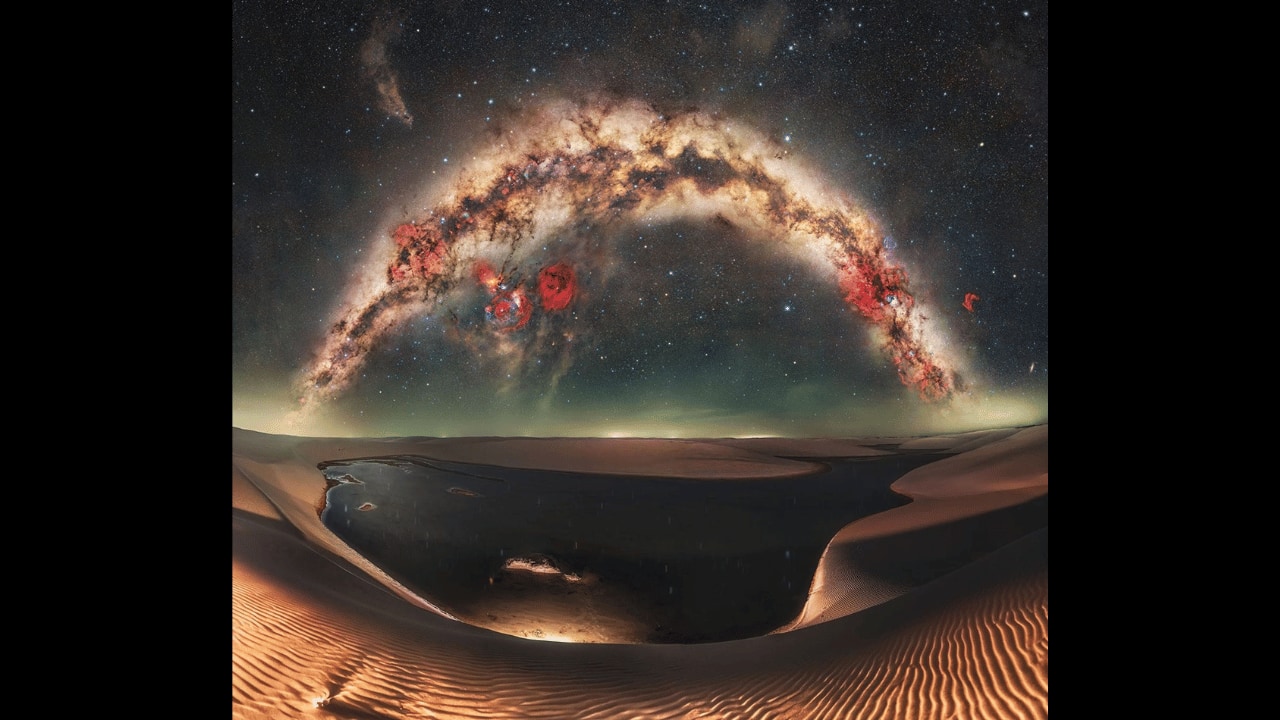
Titled “Eye in the Sky: The Milky Way over Lençóis” the photograph shows the Milky Way stretching across the night sky like a giant glowing arch, perfectly framing a dark lagoon surrounded by white sand dunes in Brazil.
The result looks remarkably like a giant eye, with half of it hidden in the night sky and the other half reflected in the landscape below.
Credit: Ignacio Fernández. Featured as NASA's Astronomy Picture of the Day (APOD) on November 26, 2026.
Where was it taken?
Lençóis Maranhenses National Park in northeastern Brazil, in Maranhão state.
The park is famous for its sweeping white sand dunes and dark seasonal lagoons. It looks like a desert, but it is not one.
During the rainy season, roughly January to July, rain raises the water table and fills the hollows between the dunes. The result is a maze of temporary lagoons among the white sand. The park covers 156,562 hectares and was added to UNESCO's World Heritage List in July 2024.
Landsat 9 captured hundreds of those freshwater lagoons from space on June 8, 2026 — blue and green patches against pale sand.
Why does it look like an eye?
The unusual appearance is not how the Milky Way actually looks.
According to NASA: “Does the Galaxy really appear arched like a rainbow in the sky? No, this is an artifact of a picture taken with a wide-angle lens.”
The photographer carefully framed the Milky Way against the contour of the dark lagoon. That alignment created the illusion.
The image is a composite photograph captured later in the night in July from a location approximately 2 degrees south of the equator.
As Earth rotates, we see different parts of the Milky Way as it apparently rotates in the sky every night and throughout the year.
What you can see in the galaxy?
Beyond the eye-like shape, the photograph captures real features:
*Dark dust lanes:* Dark patches running through the Milky Way. These regions contain interstellar dust that blocks visible light from stars behind them.
*Colourful nebulas:* Bright red and pink regions — enormous clouds of gas and dust associated with star formation.
We see the Milky Way as a band because we are looking from inside it, along the disk where stars are concentrated — not face-on like the spiral in illustrations.
NASA's question—
NASA ends its caption with a question:
“As the Galaxy was artfully framed by the photographer, it matches the contour of the dark lagoon creating the illusion of a cosmic eye, half in space and half on the ground. Is this eye in the sky looking back at you?”
Beauty is in the eye of the beholder. And in this case, the beholder is us.
*Tags:*
#NASA #APOD #MilkyWay #CosmicEye #LençóisMaranhenses #Brazil #Astrophotography #Space #IgnacioFernández #Universe