

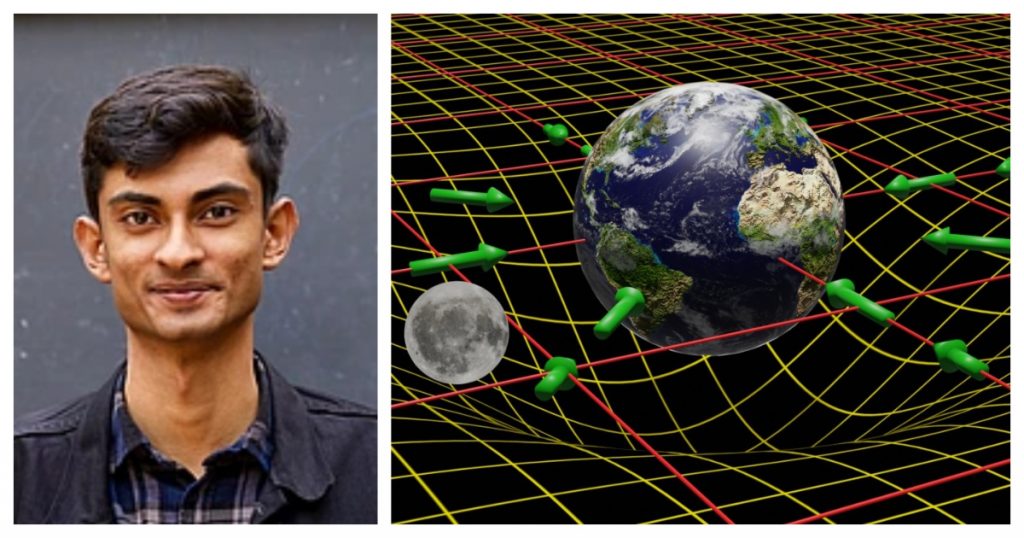
PALO ALTO: Solving quantum gravity is widely seen as the biggest open question in fundamental physics — how to reconcile Einstein's general relativity with quantum mechanics.
A paper posted to arXiv on November 25 now takes a serious shot at it.
In "An algebraic quantization of gravity from the null cone" (arXiv:2611.34924), Venkatesa Chandrasekaran of Stanford's Leinweber Institute for Theoretical Physics proposes a background-independent quantization of vacuum general relativity in four-dimensional spacetime.
He is the paper's only author. In the acknowledgements, he says several calculations and proofs came out of months of work with OpenAI's GPT-6 Astra, which used about 400 million tokens of compute provided by OpenAI.
He also thanks Sam Altman, Sébastien Bubeck and OpenAI colleagues for encouragement, and physicists including Juan Maldacena, Andy Strominger, Eva Silverstein, Raphael Bousso and Tom Hartman for discussions.
Starting from light, not snapshots—
Most approaches slice spacetime into snapshots at different moments. Chandrasekaran starts from a different place: the light cone.
Take two events. The cone spreading forward from the earlier event and the cone converging backward onto the later one overlap and enclose a diamond-shaped region — a causal diamond.
Chandrasekaran solves the gravitational constraints on intersecting null cones that bound such a region, turns the resulting classical brackets into quantum commutation relations, and builds a Hilbert space on which the algebra of observables acts.
Gluing amplitudes between states prepared on null cones gives a Lorentzian path integral in which, the author says, every sum over intermediate states converges absolutely.
The idea of quantizing gravity on null surfaces is not entirely new. What is new is claiming to do it fully, non-perturbatively, at finite Newton's constant $G_N$, without first expanding around a fixed background.
The checks that got attention—
*1. Finite graviton amplitude:* The paper computes graviton pair creation and annihilation on a null cone without expanding in $G_N$ and gets a finite closed-form answer. Expanding first in the coupling gives a logarithmic divergence.
Order matters: sum first, keep gravity finite, get finite. Expand first, get infinity.
*2. Finite states:* A causal diamond of bounded size — set by what Chandrasekaran calls a gravitational clock — has a finite-dimensional Hilbert space. Only a finite number of distinct quantum states fit inside.
*3. Black hole entropy:* It recovers the Bekenstein-Hawking entropy for marginally trapped surfaces, and finds a one-loop logarithmic correction for large Schwarzschild black holes that matches the coefficient Ashoke Sen obtained with Euclidean methods.
*4. Einstein emerges:* The final section derives Einstein's equations, along with the first layer of quantum corrections, as the low-energy limit.
The paper also touches on the speculative ER = EPR idea, which links wormholes to quantum entanglement.
What it does NOT do—
It is purely theoretical. No experimental test.
It covers only vacuum gravity. Matter is not yet included. It does not unify gravity with electromagnetism, the strong force or the weak force.
It leaves open whether different choices in building the quantum state space lead to equivalent theories, and whether the black hole and low-energy calculations hold beyond the first quantum correction.
The AI question—
The 400 million token figure is a rare public data point on what a long human-AI research partnership costs in compute.
But the paper does not say which calculations or proofs came from the model. That makes it hard to judge how much of the core insight came from the AI and how much from the physicist.
Context: In October, the TheoPhysEval benchmark built by about 30-35 physicists found GPT-6 Astra solved 49 of 50 unpublished research-level theoretical physics problems, several in black hole physics, at under $3 per problem on average.
OpenAI had earlier claimed GPT-6 Astra led the proof behind a candidate lattice definition of the Standard Model.
Skepticism—
Jonathan Oppenheim, professor at University College London, argued the paper does not establish a quantum theory of gravity.
Others note: arXiv is a preprint server, not peer review. No outside physicist had published a full assessment by Thursday.
Chandrasekaran himself frames it as a proposal, not a proof of a finished theory.
Who is Ven Chandrasekaran?
Venkatesa "Ven" Chandrasekaran is a theoretical physicist specialising in general relativity, quantum field theory and quantum gravity. PhD in physics at UC Berkeley in 2021. Now at Stanford's Leinweber Institute.
Reports describe him as also affiliated with OpenAI's reasoning team, though the paper lists only Stanford.
Why it matters anyway?
Even if this specific construction fails, it signals a shift: AI is no longer just summarising papers. It is doing months-long back-and-forth on calculations and proofs at the frontier of physics.
Whether that produces a true theory of quantum gravity — or just a very sophisticated mirage — is now for the physics community to decide.
*Tags:*
#QuantumGravity #GPT6Astra #OpenAI #Stanford #VenkatesaChandrasekaran #Physics #arXiv #BlackHoles #Einstein #AI