

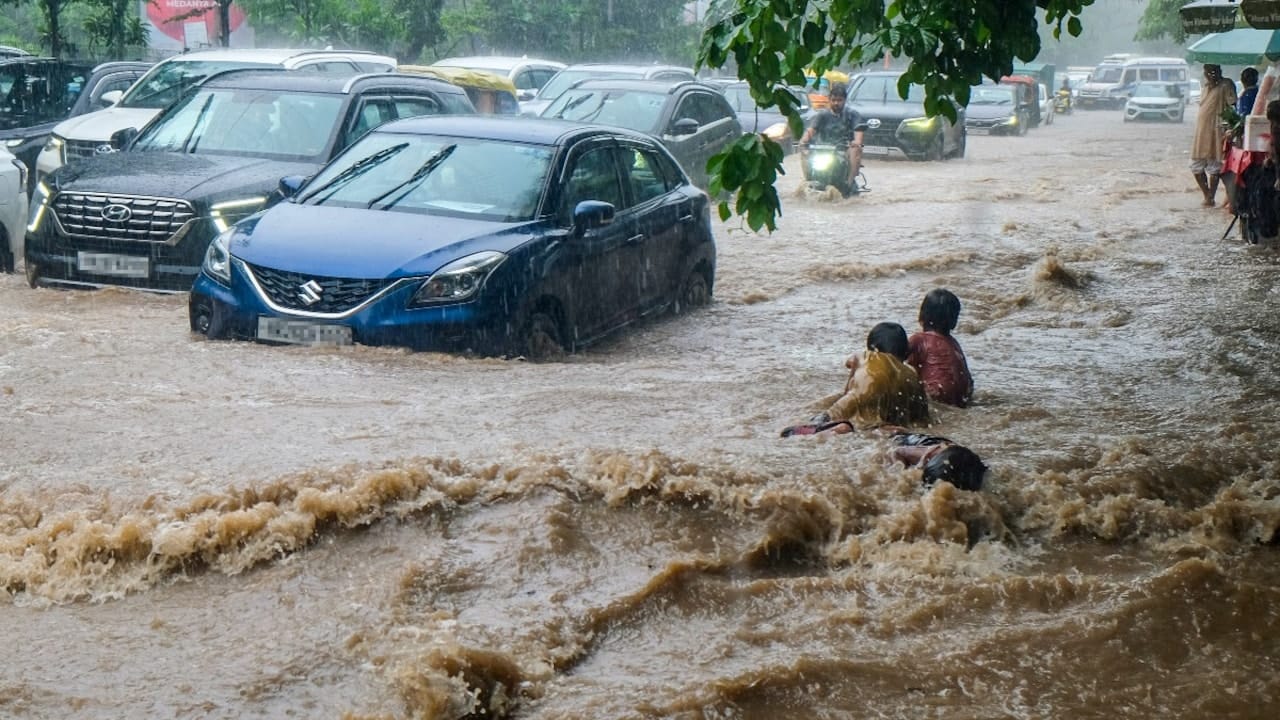
The Central Ground Water Authority (CGWA) affidavit before Punjab and Haryana High Court has exposed Gurugram's ultimate urban paradox. While streets flood every monsoon, the aquifer beneath is collapsing. Data submitted by Scientist Vidya Nand reveals depth to water level (DTWL) during pre-monsoon 2025 and 2026 at seven urban monitoring points ranging from 2.5 mbgl to 50.30 mbgl.
Out of seven locations, six showed a fall over the past year. The sharpest decline was at Karola — water table plummeted 5.41 metres. Kherki Daula recorded the deepest — 50.30 metres below ground level, down 1.10 m in a year. Only Baliawas showed a marginal rise. Four sites now have groundwater deeper than 20 mbgl. Even after monsoon, recovery is patchy: at Baliawas only, with CGWA noting localized regulatory success.
Read more- Alert For Heavy Rain Across The Country
The High Court bench of Chief Justice Ashwani Kumar Mishra and Justice Ashri Kapoor on September 22 called the Millennium City's trajectory a "grim" future unless aggressive remedial measures are taken. The CGWA report was filed in a petition since 2008 by Sunil Singh and Qutab Enclave Residents' Welfare Association challenging rapid real estate expansion including DLF Cyber City across Sectors 24, 25, 25A without commensurate water supply, drainage, or environmental clearances and heavy reliance on unmetered private tube wells.
The state argues regulation lies with Haryana Water Resources Authority (HWRA) and that statutory groundwater regulation exists. But the data shows sharp spatial variations — maximum annual rise at Khawaspur by 4.23 metres versus steepest fall at Karola — indicating highly localized exploitation rather than aquifer-wide management.
Read more- The Sinking Metropolis
Across wider Gurugram district, Ground Water Cell Haryana reports pre-monsoon levels from 1.0 mbgl to 50.3 mbgl in 2026, versus 1.3 to 49.6 mbgl in 2025, with deepest at Tatarpur 49.6 mbgl. The city's inability to channel storm runoff into aquifers — due to concretization, lack of drainage, unregulated extraction — means it suffers both extremes simultaneously: urban flood and aquifer famine.
Tags: #Gurugram #GroundwaterCrisis #CGWA #WaterTable #UrbanFlooding #Haryana #DLF #WaterScarcity #SustainableDevelopment #PunjabHaryanaHC